 how-to
How to Choose the Right Pressure Washer Nozzle
Last Updated: November 5, 2026
Quick Summary
Choose a pressure washer nozzle by matching its spray angle to the surface, starting wide and moving closer only if dirt does not lift. Colour codes show the angle, from red at 0 degrees to white at 40 degrees. Always check that the nozzle size matches your machine's GPM and PSI.
- Use a white (40-degree) nozzle for timber decks and delicate surfaces.
- Keep the wand at least 30 centimetres from timber or painted siding.
- Never use a red (0-degree) nozzle on timber or painted siding.
- Match the nozzle size number to your machine's GPM at its rated PSI.
- Replace a nozzle when the spray pattern is uneven or cleaning slows down.
Table of Contents
- Why the Nozzle Matters More Than You Think
- Understanding Pressure Washer Nozzle Colour Codes
- Pressure Washer Nozzle Degrees Explained
- How to Calculate Pressure Washer Nozzle Size from GPM and PSI
- Matching Your Nozzle to the Surface, Including Timber Decking
- Electric vs Petrol Washers and Nozzle Choice
- Booking Professional Cleaning When the Job Is Too Big
- Frequently Asked Questions
Why the Nozzle Matters More Than You Think
Most people reach for the wrong pressure washer nozzle and wonder why the job takes twice as long. The nozzle decides how the water hits the surface, and that matters as much as the machine's pressure.
Matching nozzles to surfaces is where most pressure washing mistakes begin. This guide walks through how to choose the right pressure washer nozzle for your home, your deck and your budget, so you can do the job safely.
- A nozzle controls the spray width and the force at the surface.
- Too narrow a spray can etch or gouge soft surfaces.
- Too wide a spray can leave dirt behind and waste time.
- Matching the nozzle to the surface protects your property.
Understanding Pressure Washer Nozzle Colour Codes
Most pressure washer nozzles use a colour code to show their spray angle. A colour chart is a quick way to start.
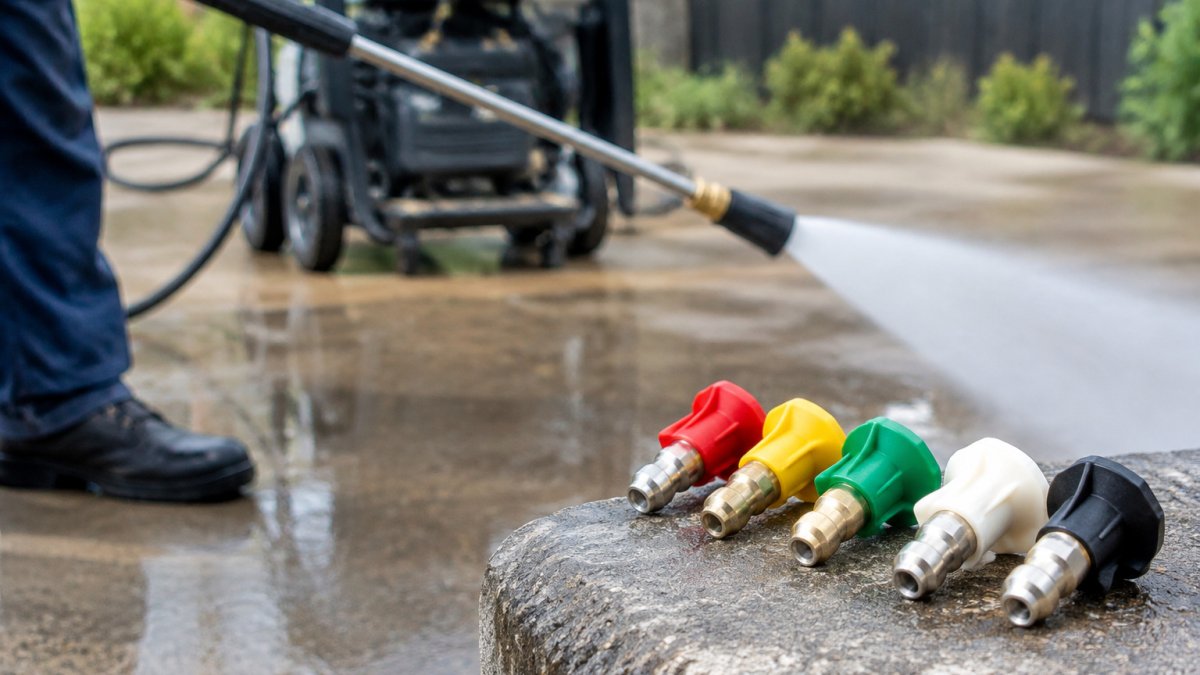
A pressure washer nozzle colour chart usually runs like this:
- Red (0 degrees): The most concentrated stream. Use it with care, and only on hard surfaces.
- Yellow (15 degrees): A tight stream for stubborn stains on concrete.
- Green (25 degrees): A general-purpose spray for most cleaning jobs.
- White (40 degrees): A wide, gentle spray for delicate surfaces.
- Black (65 degrees): Used with detergent to apply cleaning solution.
When in doubt, start with the widest spray and move closer to the surface only if the dirt does not lift.
Pressure Washer Nozzle Degrees Explained
The degree rating on a nozzle describes the width of the spray fan.
Narrow spray angles deliver more force per square centimetre. Wider angles spread that force over a bigger area, which makes them gentler.
Watch out: Holding a narrow nozzle close to timber or soft siding can leave permanent marks in minutes. Keep a safe distance and test on a hidden spot first.
The spray angle changes how much force reaches the surface, so the table below sets out the common angles against where each one fits.
| Angle | Best for | Key difference |
|---|---|---|
| 0 degrees (red) | Hard surfaces only | Most concentrated stream |
| 15 degrees (yellow) | Stubborn stains on concrete | Tight stream |
| 25 degrees (green) | General cleaning | Balanced spray |
| 40 degrees (white) | Timber, delicate surfaces | Wide, gentle spray |
| 65 degrees (black) | Applying detergent | Used with cleaning solution |
How to Calculate Pressure Washer Nozzle Size from GPM and PSI
Every pressure washer has a rated flow (GPM, or gallons per minute) and a rated pressure (PSI, or pounds per square inch). The nozzle orifice has to match those numbers, or the machine will run under strain.
The orifice is a fixed hole. The pump pushes a fixed volume of water per minute. If the hole is too small for that volume, the pump cannot move the water it is rated for, so pressure builds behind the restriction, the pump runs hot and the motor or engine labours.
Reading a Nozzle Size Number
Nozzle sizes are usually stamped as a two- or three-digit number, often with the spray angle. The size number refers to the orifice diameter in a standardised scale, not millimetres. A larger size number means a larger hole and more flow. The angle number (0, 15, 25, 40, 65) is separate and describes the fan width, not the flow.
Nozzle size numbers are matched to the machine's GPM at its rated PSI, not chosen by spray angle.
A Practical Sizing Check
- Find the GPM and PSI on your machine's label or manual. Use the rated figures, not the maximum.
- Note the nozzle size number stamped on the tip, or the size listed on the packaging.
- Compare the nozzle's rated flow at your machine's PSI with your machine's GPM. They should be close.
- If the nozzle flows more than the pump delivers, pressure will be low. If it flows less, the pump will be restricted.
- When in doubt, choose the size that matches your GPM at your rated PSI, then pick the angle for the surface.
Troubleshooting Pressure Fluctuations
A wrong orifice size is one of the most common causes of pressure that surges, drops or feels weaker than the machine's rating. A few patterns are worth knowing:
- Pressure drops when you pull the trigger: often a nozzle that is too large for the pump's GPM, so the pump cannot keep up.
- Pressure pulses or the motor labours: often a nozzle that is too small, restricting flow and loading the pump.
- Pressure is fine cold but fades as the machine warms: check for a partly blocked orifice before blaming the pump.
- Pressure is weak at every nozzle: the problem is more likely the pump, inlet filter or unloader valve than the tip.
Watch out: Never "fix" low pressure by fitting a smaller nozzle than your pump is rated for. Restricting flow to raise pressure at the wand is a common way to overheat a pump and shorten its life.
If your machine has a rated GPM figure, stick to nozzles built for that flow. The angle you choose changes the force at the surface; the size number changes whether the pump can do its job at all.
Matching Your Nozzle to the Surface, Including Timber Decking
Different surfaces need different nozzles. Concrete can take a strong stream, but timber and painted siding cannot. Matching the nozzle to the surface is the single most important step in this guide.
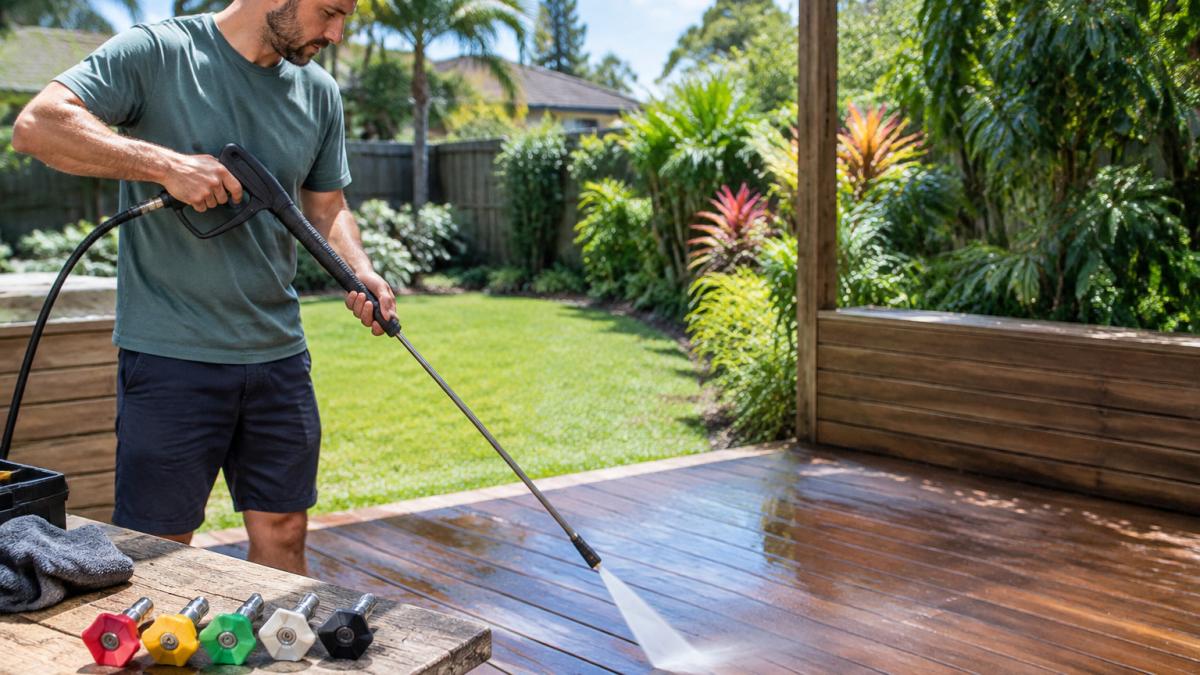
Common surface matches:
- Concrete driveways and paths: Green or yellow nozzles for general cleaning, with a red nozzle only for oil stains.
- Brick and stone: Green or white nozzles, keeping a steady distance.
- Vehicles and glass: White or black nozzles, with detergent where needed.
- Timber decking: White nozzles at a wide angle, moving constantly.
Timber decking needs the most care. Timber is soft, and a narrow jet can raise grain, split boards and leave pale streaks that last for years. Sweep the spray along the grain, keep it moving, and stay well back.
Safe Settings for Timber Decks and Residential Siding
Timber and siding are the surfaces most often damaged by pressure washing. Good habits protect them.
- Start with a white (40-degree) nozzle, even if you think you need more force.
- Keep the wand at least 30 centimetres from the surface.
- Work along the grain of the timber, never across it.
- Test a small hidden area first to check for damage.
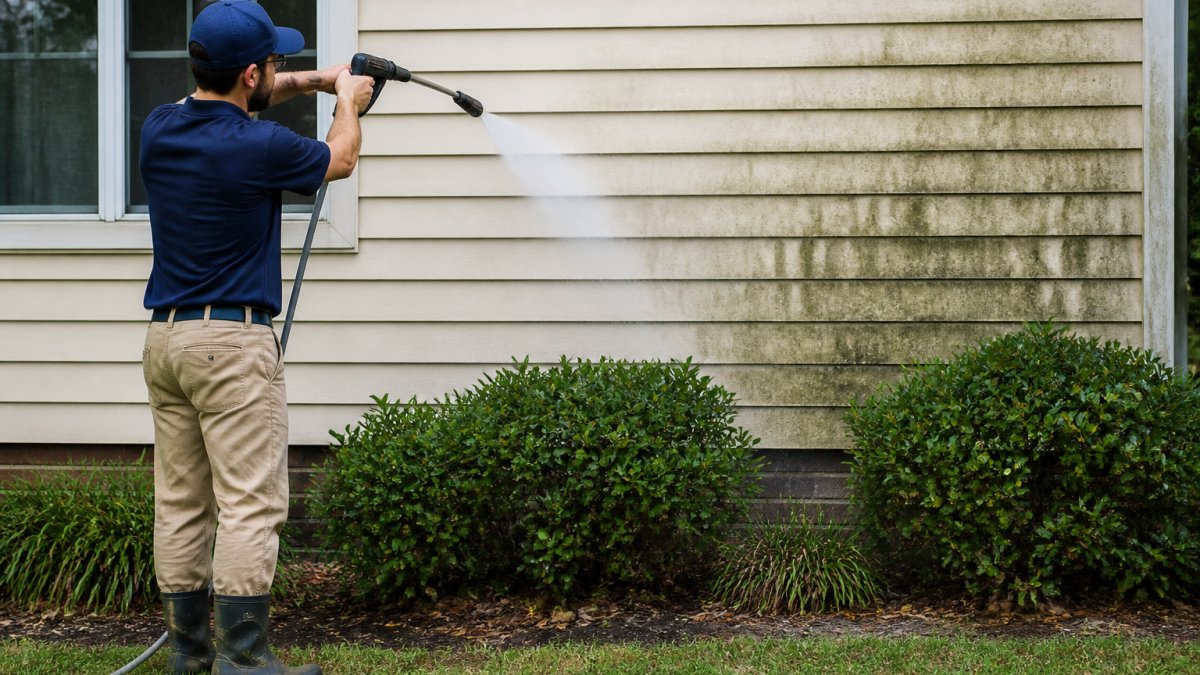
- Use a low-pressure detergent on siding to lift mould gently.
To clean a deck the safe way, read How to Clean Timber Decks Without Damage. Our general pressure washing safety tips for homeowners are also worth a read before you start.
Watch out: Never use a red (0-degree) nozzle on timber or painted siding. It can strip the surface in seconds.
For a deck or siding job, the safe settings above are a good starting point. For a full guide to cleaning these surfaces with the right PSI, nozzle and technique, see Safe Pressure Washing for Old Decks: A How-To Guide.
Electric vs Petrol Washers and Nozzle Choice
Electric and petrol pressure washers behave differently, and that changes how you choose a nozzle. Most guides gloss over this, but the machine type determines which orifice sizes and angles will actually work.
Electric models are usually lighter and deliver lower flow than petrol models, which typically push more water and pressure. The nozzle has to suit the pump, not the other way around.
- Electric washers: Lower GPM means a smaller orifice is often correct, but very narrow tips can overload the motor because they restrict flow. Choose nozzles rated for the machine's flow, and favour wider angles for general work.
- Petrol washers: Higher GPM and PSI can handle a wider range of orifice sizes, but the size number still has to match the rated flow. A petrol machine with a mismatched tip will surge or bog down just like an electric one.
- Both types: Check the manufacturer's rated flow before buying a replacement nozzle, and keep the size number consistent when you swap angles.
A practical rule many operators use: match the nozzle size number to the machine's GPM at its rated PSI, then choose the angle for the surface.
Nozzle Wear and Replacement Indicators
Nozzle wear is the gap most selection guides leave out. Over time the orifice opens up, which lowers pressure and makes the spray less effective.
Look for these indicators:
- An uneven or lopsided spray pattern instead of a clean fan.
- A jet that looks thicker or fuzzier than it did when new.
- Cleaning taking longer on a surface that used to come clean quickly.
- Pressure that feels weaker at the wand with no change to the machine.
- Visible scoring or enlargement of the orifice when you hold the tip up to the light.
A common pattern is that a worn tip is replaced only after a pump has been blamed. Checking the nozzle first is quicker and cheaper.
Watch out: A worn nozzle on a petrol machine can mask a pump problem, because the pressure loss looks like a machine fault. Swap in a known-good tip before assuming the pump is failing.
Booking Professional Cleaning When the Job Is Too Big
Some jobs are better left to the pros. Large driveways, multi-storey buildings and heavy graffiti often need equipment and experience that go beyond a home machine.
Consider a professional when:
- The surface is large or hard to reach.
- The stains are deep, old or chemical.
- You are cleaning timber that may be damaged.
- You need the job done fast, for example before selling a home.
If the job is too big, you can book a driveway pressure cleaning quote and compare the scope of work. To weigh up providers, read the guide on how to evaluate a pressure cleaning company before you commit.
When you are ready, reach out to AquaBlast Elite to book a clean. Our team covers Sydney and the surrounding areas.
Frequently Asked Questions
What do the different colours of pressure washer nozzles mean?
Most pressure washer nozzles use a standard colour code that indicates the spray angle. Red is typically 0 degrees, a concentrated jet with the most force. Yellow is 15 degrees, green is 25 degrees, white is 40 degrees and black is a low-pressure soap nozzle. The colour tells you the angle, not the flow rate, so always check the manufacturer's specification for GPM and PSI as well. Using a colour chart helps you pick a starting point, but test on a small hidden area first before working across the whole surface.
Can using the wrong pressure washer nozzle damage my property?
Yes. A narrow 0-degree red nozzle held close to the surface can etch concrete, strip paint, gouge softwood and force water into timber joints. Even a 15-degree yellow nozzle can damage weathered boards if held too close. A wider 40-degree white nozzle or a soap nozzle is a safer starting point for decks, siding and painted surfaces. Keep the wand moving, maintain a safe distance and start with the widest spray pattern that still removes the dirt.
What is the difference between a 0-degree and a 40-degree nozzle?
A 0-degree nozzle produces a tight, concentrated jet with the highest impact force. It suits stubborn stains on hard surfaces such as concrete driveways. A 40-degree nozzle sprays a wide fan with much lower impact force, which makes it suitable for delicate surfaces like timber decking, vehicles and painted walls. Between them, the 15-degree and 25-degree nozzles offer a balance for general cleaning. Choose the angle based on the surface's tolerance, not on how fast you want the job finished.
When should I use a soap nozzle for pressure cleaning?
Use a soap or low-pressure nozzle when you are applying detergent, degreaser or a mould treatment to a surface. These nozzles draw the cleaning solution into the water stream at low pressure, so it can dwell on surfaces such as roof tiles, cars and outdoor furniture. Rinse the surface with a higher-angle nozzle afterwards to remove the residue. Never apply strong detergent with a high-pressure red or yellow nozzle, as the chemical will not reach the surface properly.