 blog
blog
5 Best Commercial Pressure Cleaning Services in Sydney (2026)
Table of Contents
- Commercial Pressure Cleaning in Sydney: Quick Comparison
- Commercial Pressure Cleaning Cost Per Square Metre: What Drives the Price
- The Benefits of Professional Soft Washing for Businesses
- Commercial Pressure Cleaning Safety Standards Every Provider Must Meet
- Environmental Compliance and Water Runoff Rules
- Maintenance Schedules for Strata and Commercial Properties
- How to Choose the Right Provider for Your Property
- Frequently Asked Questions
Last Updated: September 14, 2026
Commercial Pressure Cleaning in Sydney: Quick Comparison
Finding the right commercial pressure cleaning provider in Sydney comes down to three things: equipment capability, compliance, and how they handle your specific surface types. This guide from AquaBlast Elite breaks down what separates a professional operator from a cheap quote that costs you more in repairs.
The commercial pressure cleaning market has matured significantly. Property managers now ask harder questions about water recycling, insurance coverage, and surface-specific methods before signing a contract. That scrutiny is justified. A botched high-pressure job on a heritage facade or a loading dock can create five-figure remediation costs.
Below, we compare the factors that actually matter when evaluating providers, from pricing structures to safety standards to environmental compliance. The five key evaluation criteria we cover will help you shortlist providers with confidence.
Safe Work Australia's guide to managing risks in construction and maintenance work
| Evaluation Factor | What to Check | Why It Matters |
|---|---|---|
| Equipment capability | PSI rating, rotary surface cleaners, high-reach booms | Determines which surfaces can be cleaned safely |
| Insurance and licensing | Public liability cover, police checks, SWMS documentation | Protects you if damage or injury occurs |
| Environmental compliance | Water recycling, biodegradable detergents, runoff control | Avoids EPA penalties and protects stormwater |
| Surface expertise | Soft washing vs high pressure, sealing, algae treatment | Prevents irreversible damage to delicate materials |
| Maintenance options | Scheduled programs, graffiti prevention, reporting | Reduces long-term costs for strata and commercial sites |
Commercial Pressure Cleaning Cost Per Square Metre: What Drives the Price
Commercial pressure cleaning cost per square metre varies based on access difficulty, surface material, and how often the work needs repeating. Providers quote per square metre for open, flat areas and per hour for complex or high-reach work.
Site Access, Height and Surface Type
Access is the single biggest cost lever. Ground-level concrete driveways clean quickly with a rotary surface cleaner. A multi-storey facade requiring elevated work platforms, boom lifts, or rope access takes far longer and requires additional safety planning. Tiled surfaces, timber decking, and painted render need lower pressures and different nozzles, which slows the job.
Frequency, Water Access and Waste Disposal
Scheduled maintenance programs cost less per visit than one-off cleans. When a provider can plan recurring work, they allocate crews more efficiently and you avoid the premium attached to emergency callouts. On-site water access and containment requirements for runoff also affect pricing. Sites without a suitable water point may need a tanker, and sites near stormwater drains require containment and disposal procedures that add labour.
Request an itemised quote that separates labour, equipment, water sourcing, and waste disposal. That transparency makes it easy to compare providers fairly and spot suspiciously low bids. For current rates, check the Sydney Water trade waste and water efficiency guidance or contact AquaBlast Elite directly for a tailored assessment.
The Benefits of Professional Soft Washing for Businesses
Soft washing uses low pressure, typically under 500 PSI, combined with biodegradable detergents to clean surfaces that high pressure would destroy. For businesses, the benefits extend beyond aesthetics: it protects asset value, extends repaint cycles, and removes biological growth at the source rather than blasting the visible layer off.
Traditional high-pressure blasting can force water behind cladding, strip paint, etch timber grain, and open mortar joints on older masonry. Soft washing applies cleaning solutions at low pressure, letting the chemistry do the work. The result is a deeper clean that kills mould, mildew, and algae at the root.
Matching the Method to the Surface
Most commercial sites contain a mix of materials, and the correct method changes from one to the next. A provider who defaults to full pressure on everything is a liability. Use this as a working guide when you brief a contractor:
| Surface | Recommended Method | Pressure Guide | Key Risk If Done Wrong |
|---|---|---|---|
| Concrete driveways and hardstands | High pressure with rotary surface cleaner | 2,500-4,000 PSI | Etching and striping from a stationary nozzle |
| Sandstone and heritage masonry | Soft wash, low pressure, pH-matched detergent | Under 500 PSI | Permanent pitting and loss of heritage character |
| Brick and rendered facades | Soft wash, then controlled rinse | 500-1,500 PSI | Blown mortar joints and water ingress |
| Painted render and weatherboards | Soft wash only | Under 500 PSI | Paint stripping and substrate saturation |
| Timber decking | Soft wash with wood-safe detergent | Under 500 PSI | Raised grain, splintering, coating failure |
| Tiled and paved pedestrian areas | Medium pressure with fan nozzle | 1,000-2,000 PSI | Grout erosion and efflorescence |
| Colorbond and metal cladding | Soft wash, low pressure | Under 500 PSI | Seal and coating damage |
Sandstone deserves a specific mention. It is porous, relatively soft, and common on older commercial and heritage buildings. High pressure drives water into the stone, accelerates salt attack, and can permanently scar the face. A soft wash with a pH-appropriate detergent, followed by a low-pressure rinse, is the only safe approach.
Why This Matters Commercially
- Removes mould and mildew without damaging render, weatherboards, or painted surfaces
- Biodegradable detergents break down organic growth at the root, so regrowth is slower
- Extends the life of surface coatings and reduces repainting frequency
- Safe for heritage facades, awnings, and signage
- Lower water consumption than sustained high-pressure washing
- Reduces the risk of water ingress behind cladding, which is a common cause of internal mould claims
Commercial Pressure Cleaning Safety Standards Every Provider Must Meet
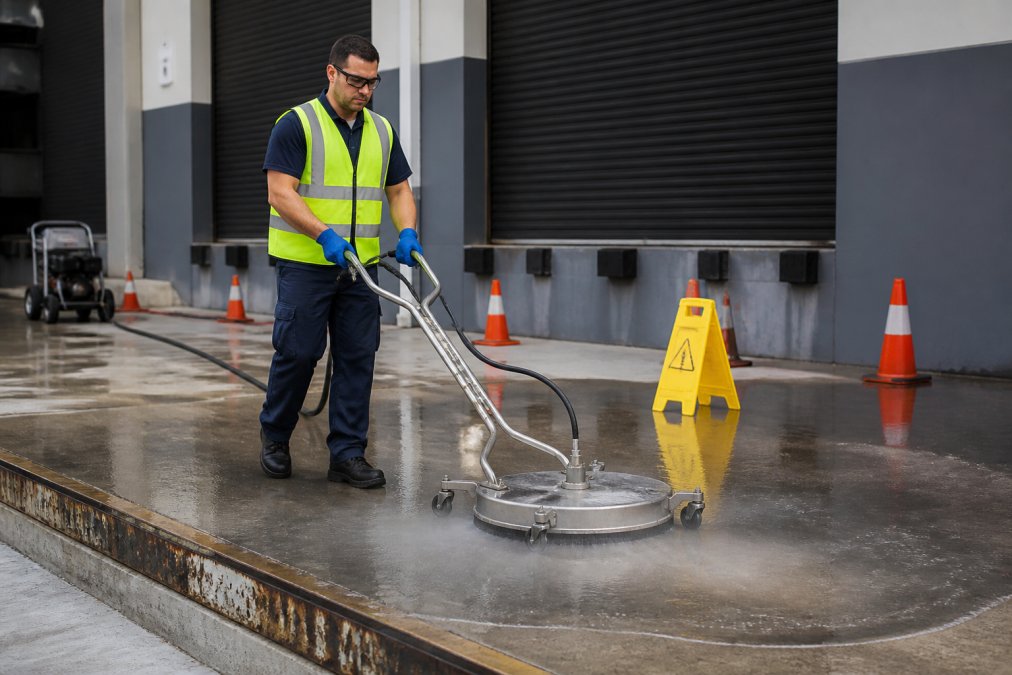
Every commercial pressure cleaning provider must meet safety standards covering equipment inspection, operator competency, and site-specific risk controls. In practice, that means documented safe work method statements, appropriate PPE, and compliance with work health and safety legislation.
High-pressure water at 3,000+ PSI can cause serious lacerations and injection injuries. Electrical hazards near outlets, slip risks from runoff, and working-at-height risks on facades all require formal controls. Reputable providers carry current public liability insurance, conduct police checks on staff, and prepare a site assessment before work begins.
Ask to see:
- Current public liability insurance certificate
- Safe work method statements for your specific site
- Operator training records and equipment maintenance logs
- Police checks for crew attending your property
- A written site assessment identifying hazards and controls
The Safe Work Australia model WHS regulations set the baseline. A provider who hesitates to share documentation is one to avoid.
Environmental Compliance and Water Runoff Rules
Environmental compliance is where many cheap operators fall short, and it is the area where property owners carry the most hidden risk. Runoff from pressure cleaning carries detergents, oils, heavy metals, and biological matter into stormwater systems, and that discharge is regulated at both state and local level.
In New South Wales, trade wastewater, the liquid waste generated by a commercial activity, is controlled under the Protection of the Environment Operations Act 1997 and administered by the Environment Protection Authority. Local councils and Sydney Water add their own requirements on top, particularly for discharge to the sewer. The practical effect is that a commercial cleaning job is not just a cleaning job; it is a waste management activity.
What Compliant Runoff Management Looks Like
A compliant provider does not let wash water reach a stormwater drain. Instead, the standard approach is:
- Containment, bunding, berms, or vacuum booms to hold wash water on site
- Capture, a wet vacuum or sump pump to collect the contained water
- Treatment, oil-water separators, sediment filters, or pH adjustment where required
- Disposal, discharge to sewer under a trade waste agreement, or removal by a licensed liquid waste contractor
For routine exterior cleaning with biodegradable detergents, some sites can discharge to sewer under a trade waste agreement. For oil stain removal, industrial degreasing, or any job involving hydrocarbons, the wastewater must be captured and disposed of through licensed channels. It cannot be hosed into a drain, and it cannot be left to soak into the ground.
What to Verify Before You Sign
- Runoff containment and recovery methods, described in writing
- Safety data sheets for every detergent used on your site
- Trade waste disposal documentation or a current trade waste agreement
- Water conservation measures such as recycling systems or low-flow equipment
- Confirmation of which drains on your site are stormwater and which are sewer
Why This Is a Commercial Issue, Not Just an Environmental One
For property managers and strata committees, runoff compliance is a governance issue. A single incident, a contractor washing a loading dock and sending oil-laden water into the stormwater system, can trigger a council investigation, a clean-up notice, and reputational damage. The cost of a compliant job is almost always lower than the cost of a non-compliant one that gets reported.
When you shortlist providers, ask for their runoff management procedure as a standard part of the quote. A provider who can explain containment, capture, treatment, and disposal without hesitation is one who has done the work before. A provider who cannot is a risk you are taking on.
Environment Protection Authority guidance on trade wastewater and pollution incidents
Maintenance Schedules for Strata and Commercial Properties
Scheduled maintenance beats reactive cleaning on both cost and appearance. Strata buildings, retail centres, and industrial facilities benefit from a recurring program that addresses surfaces before damage accumulates.
A practical annual schedule looks like this:
| Property Type | Frequency | Key Surfaces |
|---|---|---|
| Strata complexes | Quarterly | Common areas, driveways, bin rooms |
| Retail and hospitality | Monthly | Entrances, awning exteriors, paving |
| Industrial facilities | Quarterly to biannually | Loading docks, hardstands, facades |
| Office buildings | Biannually | Facade, entryways, car parks |
Graffiti removal is a special case. High-traffic commercial sites benefit from a maintenance plan that includes rapid response and surface sealing, which makes future tags easier and cheaper to remove. AquaBlast Elite offers customised solutions for every project.
How to Choose the Right Provider for Your Property
Choosing a provider starts with a site assessment, not a phone quote. A capable operator inspects your surfaces, identifies access constraints, and recommends a method before pricing anything.
Use this checklist when shortlisting:
- Provider conducts a physical site assessment before quoting
- Written quote itemises labour, equipment, and disposal
- Insurance certificates and police checks provided on request
- Surface-specific methods explained (soft washing vs high pressure)
- Environmental compliance and runoff management documented
- References or before-and-after examples from similar properties
- Maintenance options offered, not just one-off cleans
AquaBlast Elite handles residential, commercial, and industrial projects across Sydney and surrounds, with customised solutions for every surface type. Our team uses high-reach equipment and surface-appropriate methods to restore concrete, decking, facades, and graffiti-affected areas without causing damage.
Frequently Asked Questions
What is the difference between pressure washing and soft washing for commercial buildings?
Pressure washing uses high-PSI water to strip grime from hard surfaces like concrete and brick. Soft washing uses low pressure with biodegradable detergents to clean delicate surfaces such as rendered walls, timber and painted facades without causing damage. For commercial buildings with mixed materials, a provider should assess each surface and choose the right method. Soft washing also treats mould, mildew and algae at the root, so results last longer between visits.
How often should commercial properties undergo professional pressure cleaning?
Most commercial properties need exterior cleaning every 6 to 12 months, depending on foot traffic, tree cover and how close the site is to busy roads. High-traffic retail entries, loading docks and car parks often need quarterly attention. Strata and industrial sites benefit from a scheduled maintenance plan so surfaces are cleaned before build-up becomes costly to remove. A site assessment will confirm the right frequency for your property.
What factors influence the commercial pressure cleaning cost per square metre?
Pricing depends on surface type, level of soiling, access requirements such as height or confined spaces, water and power availability, and how waste water is captured and disposed of. Graffiti removal, oil stain treatment and surface sealing add to the scope. Because every site is different, providers quote after a site assessment rather than giving a flat rate. Request a free quote with a clear scope of works so you can compare like for like.
Can pressure cleaning remove graffiti and oil stains from concrete?
Yes. Graffiti removal typically combines low-pressure washing with specialised biodegradable solvents, while oil stains need degreasers and hot-water cleaning to lift residue from the concrete pores. Results depend on how long the stain has been there and whether the surface was previously sealed. Sealing after cleaning makes future graffiti and oil spills easier to remove. Ask your provider whether sealing is included or quoted separately.
Commercial property maintenance is a long game, and pressure cleaning done poorly costs more than it saves. AquaBlast Elite delivers efficient, surface-specific cleaning backed by proper safety documentation, environmental compliance, and equipment suited to the job. Book a call with our team to arrange a site assessment and get a tailored quote for your property.