 blog
blog
Best Methods for Cleaning Tennis Courts in Sydney
Table of Contents
- Why Sydney's Climate Makes Tennis Court Cleaning Different
- Comparing Tennis Court Cleaning Methods by Surface Type
- How to Clean an Acrylic Tennis Court Without Damaging the Surface
- Tennis Court Moss Removal: What Works and What Doesn't
- Choosing the Right Tennis Court Cleaning Machine
- Tennis Court Cleaning Cost: What Affects the Price
- DIY vs Professional Tennis Court Cleaning: When to Call a Specialist
- Frequently Asked Questions
Last Updated: October 5, 2026
Why Sydney's Climate Makes Tennis Court Cleaning Different
Sydney's humidity, salt air and warm-season storms create a cleaning problem most court owners underestimate. The best methods for cleaning tennis courts in Sydney have to account for rapid algae regrowth, not just visible dirt. This guide from AquaBlast Elite breaks down what actually works on each surface type.
Mould and algae need moisture and warmth to establish. Coastal suburbs and the humid months from late spring through autumn give both, which is why courts here grow green film faster than courts in drier regions. A court that looks clean after a rinse can be slippery again within weeks if the underlying growth is not removed properly.
That changes the whole approach. A quick hose-down treats the symptom. Proper cleaning removes the organic growth, restores grip, and delays the next bloom.
Comparing Tennis Court Cleaning Methods by Surface Type
No single method suits every court. The right choice depends on the surface, the level of contamination, and how much pressure it can safely take.
| Method | Best For | Pressure Level | Main Risk |
|---|---|---|---|
| Soft washing | Acrylic, cushioned, painted courts | Low | Slow on heavy staining |
| Pressure washing | Concrete, synthetic hard courts | Medium to high | Coating damage if misused |
| Chemical treatment | Mildew, algae, moss | None | Runoff if unmanaged |
| Manual scrubbing | Line markings, edges | None | Labour intensive |
Acrylic and Cushioned Courts
Acrylic and cushioned courts are the most delicate. They rely on a thin coloured coating over a base, and that coating scratches, fades and lifts under aggressive pressure. Soft washing at low pressure, paired with a specialised cleaning solution, lifts algae and grime without touching the coating. This is the method we reach for first on any cushioned surface.
Concrete and Synthetic Surfaces
Concrete and synthetic hard courts tolerate more pressure, which makes pressure washing viable for embedded dirt and staining. Even here, the nozzle angle matters. Too steep an angle etches the surface and opens pores that trap dirt faster next time. A wider fan and a steady pass work better than a concentrated jet.
How to Clean an Acrylic Tennis Court Without Damaging the Surface
Cleaning an acrylic court safely comes down to pressure control, the right solution, and patience. High pressure is the enemy of a coated surface.
Here is the sequence we follow:
- Clear debris, leaves and loose grit with a blower or soft broom
- Apply an algaecide or specialised cleaning solution to affected areas
- Let the treatment dwell so it breaks down the growth
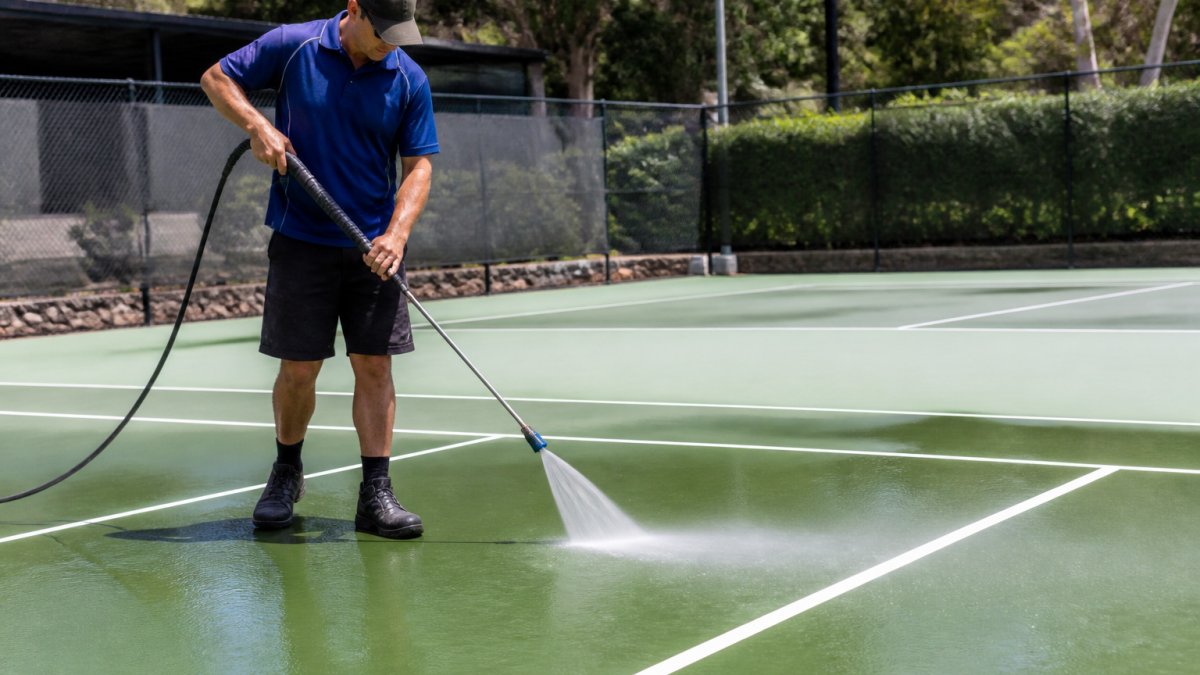
- Rinse with low-pressure water using a wide fan pattern
- Spot-treat stubborn stains by hand rather than raising pressure
- Allow the court to dry fully before play resumes
What most guides miss is the dwell time. Rushing from application to rinse leaves the roots of the growth intact, and the court goes green again within weeks. Give the solution time to work.
Tennis Court Moss Removal: What Works and What Doesn't
Moss removal on tennis courts is where DIY attempts most often go wrong. Moss grips the surface with shallow roots and thrives in shaded, damp corners, especially along fence lines and under trees.
What works: a dedicated moss treatment or algaecide applied to the affected area, followed by a low-pressure rinse once the moss has died back. Killing it first means it releases its grip, so the rinse lifts it cleanly.
What doesn't: scraping at live moss or hitting it with high pressure. Both tear at the surface and leave fragments behind to regrow.
Choosing the Right Tennis Court Cleaning Machine
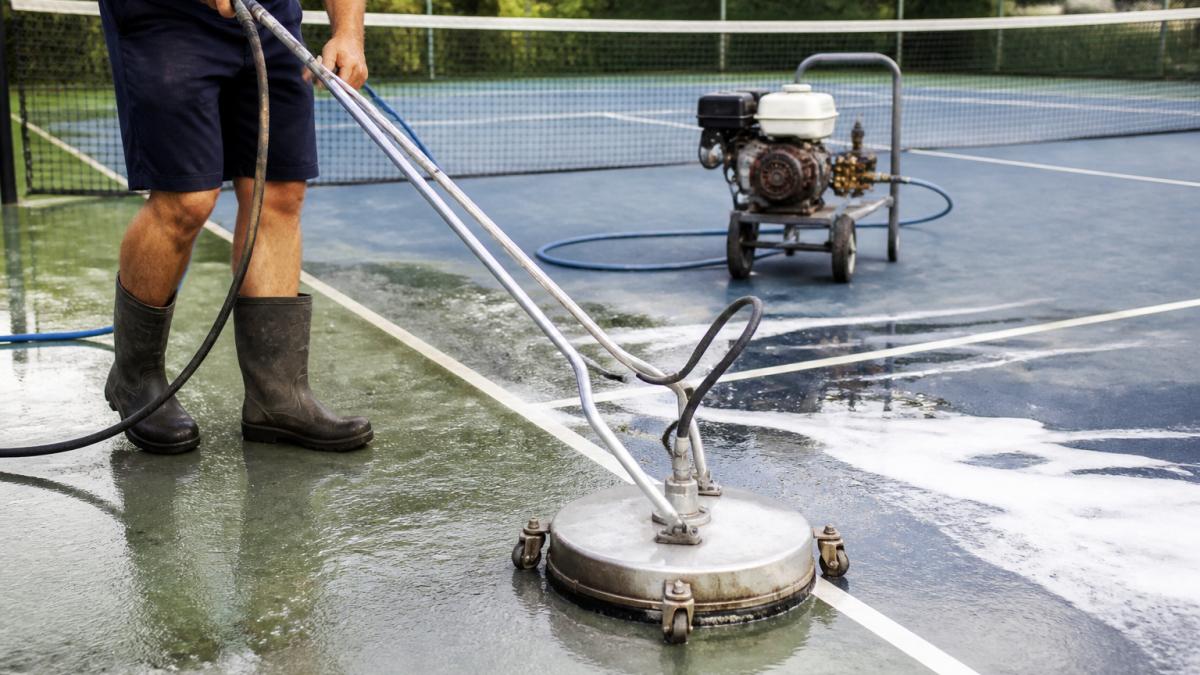
The best tennis court cleaning machine is one that lets you control pressure, not one with the most power. For most courts, a soft wash system paired with a rotary surface cleaner handles the bulk of the work, with a separate low-pressure wand for edges and coated areas.
Here is how the main equipment classes compare for court work:
| Equipment | Typical pressure | Best for | Watch out for |
|---|---|---|---|
| Soft wash system (12V or mains pump) | Under 1,000 psi | Acrylic, cushioned and painted courts | Slow on heavy staining; needs a good nozzle set |
| Electric pressure washer | 1,200-2,000 psi | Concrete and synthetic hard courts | Fixed high settings can etch or strip coatings |
| Petrol pressure washer | 2,500-4,000 psi | Bare concrete, not coated courts | Overkill for acrylic; noisy and heavier to manoeuvre |
| Rotary surface cleaner attachment | Matches host unit | Even coverage on flat concrete | Can mark coated surfaces if pressure is too high |
| Low-pressure wand | Under 500 psi | Edges, line markings, cushioned areas | Slow; needs patience on large areas |
Look for three things:
- Adjustable pressure so you can drop to low settings for coated surfaces
- A rotary surface cleaner for even coverage on flat concrete, which reduces streaking and pass marks
- A separate low-pressure wand for edges, lines and cushioned areas
A machine that only runs at full pressure forces you into a single approach. That is a problem when one court has a delicate acrylic coating and the next is bare concrete. The practical answer for anyone maintaining more than one surface is a unit with a variable pressure regulator and interchangeable nozzles, so you can match the tool to the surface rather than the other way around.
For chemical application, a dedicated downstream injector or a separate pump-up sprayer gives you control over dilution and dwell time that a pressure washer alone cannot. That matters most on moss and algae, where the treatment does the work and the rinse only lifts what the chemical has already loosened.
Tennis Court Cleaning Cost: What Affects the Price
Tennis court cleaning cost varies with the surface, the size of the court, the level of growth, and access. There is no single figure that fits every job, and any operator who quotes a flat rate over the phone without seeing the court is guessing.
That said, you can anchor your expectations. Treat these as indicative only, site conditions move the number more than anything else.
The factors that move the price most:
- Surface type, acrylic and cushioned courts need gentler, slower methods; synthetic clay and sand-filled surfaces need re-sanding after cleaning, which adds labour and material
- Contamination level, light surface grime is a single pass; established moss or black algae needs pre-treatment, dwell time and a second rinse
- Court size, full-size courts take more time than half courts or multi-use areas, and multi-court facilities are usually quoted per court
- Access, tight gates, stairs or no vehicle access for a trailer-mounted unit adds labour and setup time
- Frequency, a scheduled quarterly maintenance visit costs less per visit than a one-off restoration because growth never gets established
- Water and waste, some sites require runoff capture or trade-waste disposal, which is a separate line item
When you compare quotes, ask what is included. A fair quote should specify:
- The method proposed for your surface (soft wash, controlled pressure, chemical treatment or a combination)
- The cleaning solution and its dilution, and whether it is safe for surrounding plants and pets
- Whether line markings, fence lines and drainage are included or extra
- Whether the price covers a single visit or a treatment-and-return cycle for heavy growth
- Public liability insurance and any relevant state licensing for the operator
A walkthrough beats a phone estimate every time. Ask for the quote in writing, with the scope and method stated, so you can compare like for like rather than chasing the lowest headline number.
DIY vs Professional Tennis Court Cleaning: When to Call a Specialist
DIY cleaning suits light maintenance on a court you know well. Professional tennis court cleaning makes sense once growth is established, the surface is delicate, or you manage a commercial or school facility.
Call a specialist when:
- Moss or algae covers a large area or keeps returning
- The court has an acrylic or cushioned coating
- You manage a school, council or club facility with safety obligations
- Slip risk is a concern for players
- You need the court playable again quickly
At AquaBlast Elite, we match the method to the surface, from low-pressure soft washing on coated courts to controlled pressure cleaning on concrete. Our team services courts across the metro area and surrounds, using adjustable equipment and specialised solutions to lift growth without damaging the playing surface. If you want the job done once and done right, Safe Work Australia's guidance on managing slip hazards is a useful reference for why surface safety matters.
Frequently Asked Questions
What is the best way to clean tennis courts?
The best method depends on the surface. Acrylic courts need soft washing with low-pressure water and specialised cleaning solutions to protect the coating. Concrete courts can handle higher pressure. For all surfaces, start with debris removal, apply a treatment for mildew and algae, rinse thoroughly, and allow to dry completely before play. Professional tennis court cleaning services have the right equipment and know which water pressure is safe for each surface type.
Can you pressure wash an acrylic tennis court?
You can use a pressure washer on an acrylic tennis court, but only at low pressure. High-pressure water strips the acrylic coating, damages line markings, and creates uneven patches that affect ball bounce. Use a fan tip at 1000-1500 PSI maximum, keep the nozzle moving, and never hold it in one spot. Soft washing with low-pressure water and a cleaning treatment is the safer option for acrylic surfaces.
What kills moss on tennis courts?
Moss on tennis courts responds to several treatments including diluted bleach solutions, commercial algaecide, and oxygen-based cleaners. The key is to treat the moss, let it die, then remove it with a stiff brush or low-pressure rinse. For tennis court moss removal, avoid harsh acids that can damage the court coating. Apply treatment during dry weather, and repeat after heavy rain if regrowth appears.
How much does tennis court cleaning cost?
Tennis court cleaning cost depends on court size, surface type, contamination level, and whether you need ongoing maintenance. Request a quote based on your specific court condition. Regular preventive cleaning costs less over time than restoring a neglected surface.
Sydney's courts face constant pressure from humidity, shade and seasonal growth, and a surface left untreated becomes a slip risk long before it looks dirty. AquaBlast Elite restores and rejuvenates courts with adjustable high-pressure equipment, specialised cleaning solutions, and a method matched to each surface type. Book a call and we will assess your court and recommend the right treatment.