 how-to
Pressure Cleaning Tips for Brick Facades: A How-To Guide
Table of Contents
- Understanding Your Brick Before You Start
- Preparing Your Facade and Surrounding Area
- Pressure Washer Settings for Brick Facades
- How to Clean Brick Mortar Without Damage
- Cleaning Algae Off Brick and Other Stains
- Step-by-Step House Exterior Pressure Cleaning Process
- Common Mistakes to Avoid When Pressure Cleaning Brick
- Environmental and Safety Considerations
- Frequently Asked Questions
Last Updated: October 16, 2026
Understanding Your Brick Before You Start
Before you pick up a pressure washer, take time to assess what you're working with. Different brick ages, types, and conditions respond differently to cleaning. Getting this wrong can cause permanent damage.
Brick is porous. It absorbs water. Old mortar crumbles easily. New brick handles pressure better than heritage brick. The difference matters enormously.
Assessing brick age and condition
Older brick, especially from the 1800s and early 1900s, has softer mortar and more porous surfaces. Modern brick is denser and stronger. You need to know which you have.
Look at the mortar joints. If they're recessed deeply or crumbling when you touch them, the brick is old or the mortar is failing. Soft, chalky mortar tells you to use lower pressure or skip pressure cleaning entirely.
Run your hand across the surface. Does it feel rough and pitted, or smooth and hard? Rough, pitted brick absorbs more water and needs gentler treatment. Smooth, hard brick tolerates higher pressure.
Check for existing damage. Cracks, spalling (where chunks are missing), or flaking paint mean the surface is already compromised. Pressure cleaning will make it worse.
Identifying stains and what causes them
Not all stains are the same. What you're seeing tells you what caused it and how to treat it.
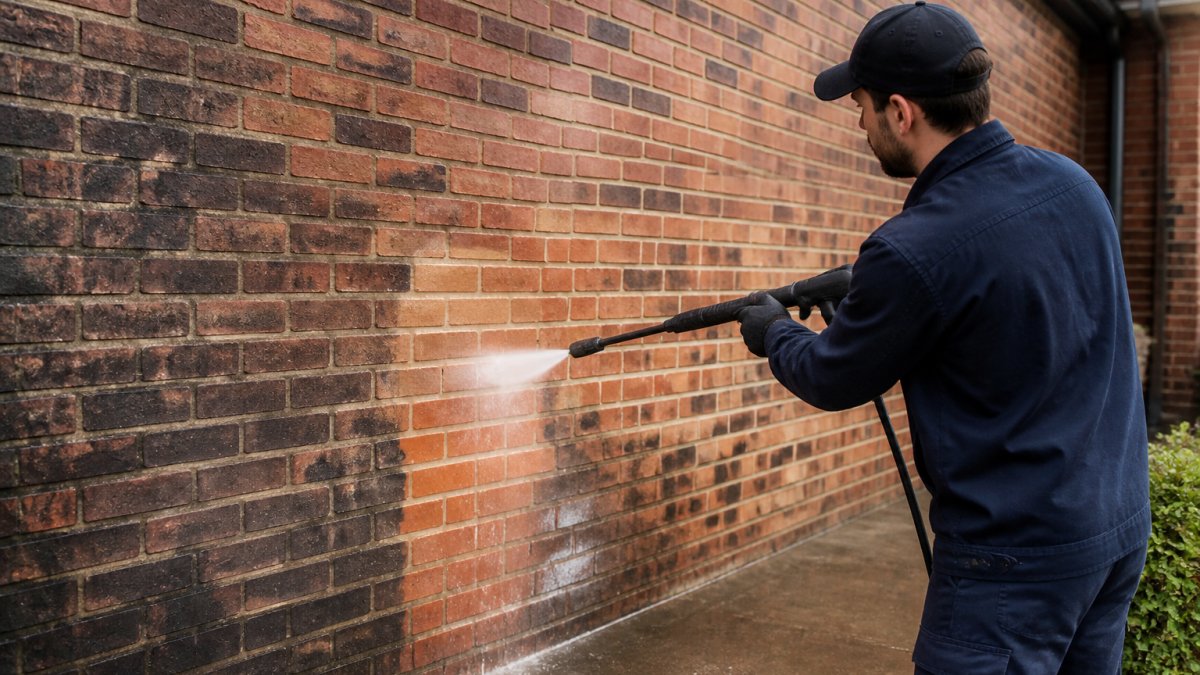
Biological growth (algae, moss, mould) appears as green, black, or brown patches. It thrives in damp, shaded areas.
Efflorescence is white, chalky deposits on the brick surface. It's mineral salts being pushed out of the brick by moisture.
Oil and grease stains are dark, oily patches that don't wash away with water alone.
Rust stains appear as orange or brown streaks, usually from metal fixtures or old nails embedded in the brick. These require specific rust-removing treatments.
Understanding the stain type helps you choose the right cleaning approach and avoid damaging the brick with the wrong method.
Preparing Your Facade and Surrounding Area
Preparation separates successful cleaning from messy disasters. Rushing this step leads to damaged plants, flooded neighbours, and water inside your home.
Start by clearing the area.
Check your gutters and downpipes. Clear debris so water flows freely.
Cover outdoor power outlets, air conditioning units, and any exposed electrical equipment. Water and electricity don't mix.
Inspect windows and doors. Close them fully. If you have weatherstripping, check that it's intact. Water will find gaps and seep inside.
Wet down adjacent plants and garden beds before you start.
Check local drainage. Understand where runoff will go. If you're near storm drains, be aware that dirty water will flow into them.
Pressure Washer Settings for Brick Facades
This is where most DIY cleaners go wrong. Too much pressure destroys brick. Too little pressure wastes time and doesn't clean.
Brick is softer than concrete. It needs lower pressure settings than you might expect.
Safe PSI and flow rate ranges
PSI stands for pounds per square inch. It's the force of the water jet.
For brick facades, stay in the 1200-1500 PSI range. This pressure removes dirt, algae, and biological growth without eroding the mortar or damaging the brick surface.
Some professionals use up to 2000 PSI on hard, modern brick in good condition. If your brick is old, soft, or already damaged, don't exceed 1200 PSI.
Flow rate matters as much as pressure. Most residential pressure washers deliver between 4.5 and 9.5 litres per minute (equivalent to 1.5-2.5 gallons per minute). Higher flow rates mean faster cleaning but also more water and runoff.
Never assume a higher-powered machine is better.
Choosing the right nozzle and spray pattern
The nozzle determines how the pressure is concentrated. A narrow nozzle focuses pressure into a tight stream. A wide nozzle spreads it out.
For brick facades, use a 25-degree or 40-degree nozzle. These spread the pressure across a wider area, reducing the risk of damage. Never use a 0-degree nozzle (pencil jet) on brick; it concentrates all the force into a pinpoint and will damage the surface.
A 40-degree nozzle is safer for old or soft brick. A 25-degree nozzle works for newer, harder brick.
Test the spray pattern on an inconspicuous area first. Start at a distance and gradually move closer to see how the brick responds.
How to Clean Brick Mortar Without Damage
Mortar is the weak link. It's softer than brick and erodes easily under pressure.
The golden rule: never aim the spray directly at mortar joints. Angle your spray slightly downward and away from the joints.
If mortar is already soft or crumbling, avoid pressure cleaning the mortar lines entirely. Focus on the brick faces only.
For stubborn dirt in mortar joints, use a soft-bristled brush and a cleaning solution instead of the pressure washer.
After pressure cleaning, inspect the mortar joints. If you see new damage or erosion, the pressure was too high. Reduce it for the rest of the facade.
If mortar joints are severely damaged, repointing (replacing the mortar) may be needed before cleaning. A mason can assess whether this is necessary.
Cleaning Algae Off Brick and Other Stains
Different stains need different approaches. Biological growth, oil, rust, and efflorescence each have specific treatments.
Pre-treatment and detergent selection
Pre-treatment softens stains and makes pressure cleaning more effective. Apply the cleaning solution and let it sit for 10-15 minutes before pressure washing.
Choose a detergent designed for brick and masonry. General-purpose cleaners can damage brick or leave residue. Look for products labelled for exterior masonry use.
Avoid bleach-based cleaners on old brick. Bleach can react with the brick chemistry and cause discolouration or further deterioration. For algae and mould, a biodegradable, pH-neutral masonry cleaner is safer.
Apply the solution with a low-pressure sprayer or a pump-up garden sprayer. Don't use the pressure washer to apply detergent; the pressure will force it too deep into the pores.
Tackling oil, mould, and biological growth
Algae and mould respond well to masonry cleaners combined with moderate pressure. Apply the cleaner, wait 15 minutes, then pressure wash at 1200-1500 PSI with a 25-degree or 40-degree nozzle.
Oil and grease stains need a degreaser. Apply it, let it sit for 20-30 minutes, then pressure wash. Some oils require a second application.
Biological growth on shaded areas is stubborn. These spots stay damp longer, so they regrow faster. After cleaning, consider improving drainage or air circulation to reduce moisture.
Never mix cleaning solutions. Combining different products can create toxic fumes or reduce effectiveness. Use one cleaner at a time.
Step-by-Step House Exterior Pressure Cleaning Process
Follow this sequence for safe, effective cleaning of your brick facade.
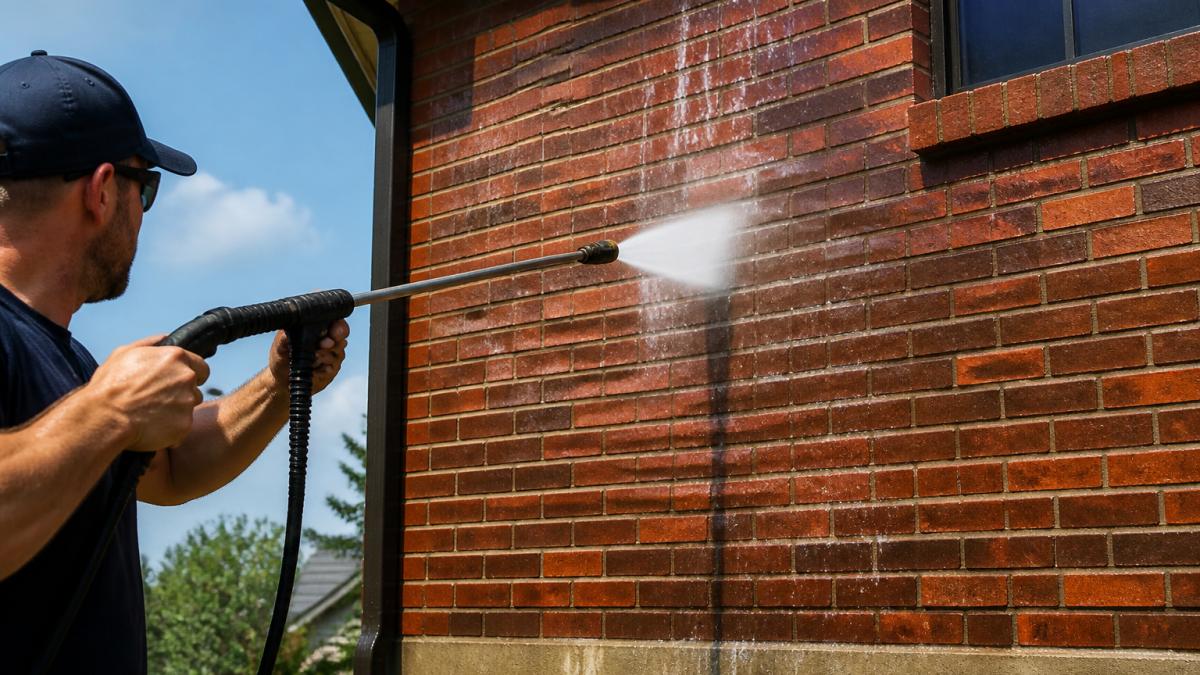
Step 1: Pre-rinse and inspect
Start at the top of the facade. Use low pressure (around 800-1000 PSI) to wet the entire surface with plain water. This loosens surface dirt and prepares the brick to absorb cleaning solution evenly.
Work from top to bottom. Gravity helps water flow down naturally. Inspect as you go. Look for areas where dirt is particularly heavy or where stains are concentrated.
Step 2: Apply cleaning solution
Mix your cleaning solution according to the product instructions. Apply it with a low-pressure sprayer or garden pump sprayer, starting at the top and working downward.
Spray the solution generously but don't oversaturate. The brick should be wet but not dripping.
Let the solution sit for 10-15 minutes. This gives it time to break down dirt and biological growth.
Step 3: Wash from top down with steady strokes
Return to the top and begin pressure washing. Use steady, even strokes. Move the wand smoothly across the brick surface as if you're painting.
Work in overlapping horizontal or vertical lines. Maintain consistent distance and pressure throughout each stroke.
Move from top to bottom. This ensures dirty water and debris flow downward, not back onto already-cleaned areas.
Step 4: Maintain proper spray distance
Start about 60 centimetres away from the brick surface. If dirt isn't coming off, move slightly closer. Never go closer than 30 centimetres.
Keep the nozzle at a slight downward angle. This helps water and debris flow away naturally.
Maintain consistent distance as you work. Varying distance causes uneven cleaning and increases the risk of damage.
Step 5: Thorough rinse and final inspection
After pressure washing with detergent, rinse the entire facade with clean water at low pressure. This removes all traces of cleaning solution and loosened dirt.
Rinse from top to bottom, using the same steady strokes as before.
Once dry (usually within 24-48 hours), inspect the results. Look for areas you may have missed or stains that need a second treatment.
Common Mistakes to Avoid When Pressure Cleaning Brick
Learning from others' mistakes saves time and protects your property.
Using too much pressure is the most common error.
Aiming at mortar joints concentrates pressure where it causes the most damage. Keep the spray angled slightly away from joints.
Skipping surface preparation leads to uneven results. Pre-rinsing and applying detergent properly make the difference between mediocre and excellent cleaning.
Pressure washing in freezing conditions traps water in brick pores. It freezes, expands, and cracks the brick.
Mixing cleaning solutions can create toxic fumes or reduce effectiveness.
Neglecting to protect gutters and drainage causes water to pool inside walls. Clear gutters before starting and direct runoff appropriately.
Starting at the bottom forces dirty water upward, re-soiling already-cleaned areas. Always work from top to bottom.
Environmental and Safety Considerations
Pressure cleaning releases water and chemicals into the environment. Being responsible protects local waterways and your neighbours.
Direct runoff away from neighbours' properties. If dirty water flows onto their land, you're liable for damage.
Check local regulations. Some areas restrict the use of certain cleaning chemicals or require permits for high-volume water use.
Use biodegradable, environmentally friendly cleaning solutions where possible. These break down naturally and reduce harm to aquatic life downstream.
Wear protective equipment. Safety glasses protect your eyes from spray and debris. Gloves protect your hands from chemicals.
Never pressure wash alone on a ladder or elevated platform.
Pressure cleaning brick facades requires patience and the right technique.
Frequently Asked Questions
What pressure should you use to clean brick?
For brick facades, use between 1200 and 1500 PSI for general cleaning. Older or damaged brick requires lower pressure, around 1000-1200 PSI. Never exceed 2000 PSI on residential brick, as higher pressures damage the mortar and the brick surface itself. Always test on an inconspicuous area first. Pressure washer settings for brick demand care; when in doubt, start low and increase gradually.
How do you clean brick mortar without damaging it?
Keep pressure below 1200 PSI and maintain a spray distance of at least 30 centimetres from the mortar joints. Use a 25-degree or 40-degree nozzle rather than a 0-degree pencil jet. Avoid directing the spray directly into mortar lines. Apply a gentle pre-rinse first, use appropriate detergent for the stain type, and rinse thoroughly from top to bottom.
Can you use household washing-up liquid to clean brick?
Household washing-up liquid is not recommended for brick facades. It can leave residue, attract dirt faster, and may harm plants and soil runoff. Instead, use cleaners specifically formulated for masonry or brick. Alkaline cleaners work well for organic stains like algae and mould, while acidic cleaners suit efflorescence and mineral deposits. Always rinse thoroughly after applying any detergent to prevent residue buildup and environmental impact.
How far should a pressure washer nozzle be from brick?
Maintain a minimum spray distance of 30 centimetres from the brick surface. For delicate or older brick, increase distance to 45-60 centimetres. Closer proximity concentrates pressure and risks damage to both the brick and mortar. Keep the nozzle at a slight downward angle to encourage water runoff. Consistent distance and steady, even strokes produce uniform cleaning without erosion or surface gouging.