 comparison
Comparing Walk-Behind and Ride-On Scrubber Efficiency
Table of Contents
- Why Scrubber Efficiency Decides Your Cleaning Budget
- Ride-On vs Walk-Behind: Core Differences in Cleaning Efficiency
- How to Calculate Floor Scrubber Cleaning Capacity Per Hour
- Floor Scrubber Coverage Rate Calculation: A Like-for-Like Method
- Walk-Behind vs Ride-On Floor Scrubber Cost: Purchase, Labour, and TCO
- Operator Ergonomics, Training, and Safety
- Floor Scrubber Maintenance Checklist for Peak Efficiency
- Which Scrubber Fits Your Facility? A Decision Framework
- Frequently Asked Questions
Last Updated: October 14, 2026
Why Scrubber Efficiency Decides Your Cleaning Budget
Scrubber efficiency is how much cleanable floor area a machine covers per hour at an acceptable standard, and it is the biggest driver of annual floor care costs.
Most buying decisions focus on purchase price, but the real money sits in ongoing costs: labour, water, detergent, battery replacement, and downtime. Get the efficiency maths right first, and the machine choice usually makes itself.
Ride-On vs Walk-Behind: Core Differences in Cleaning Efficiency
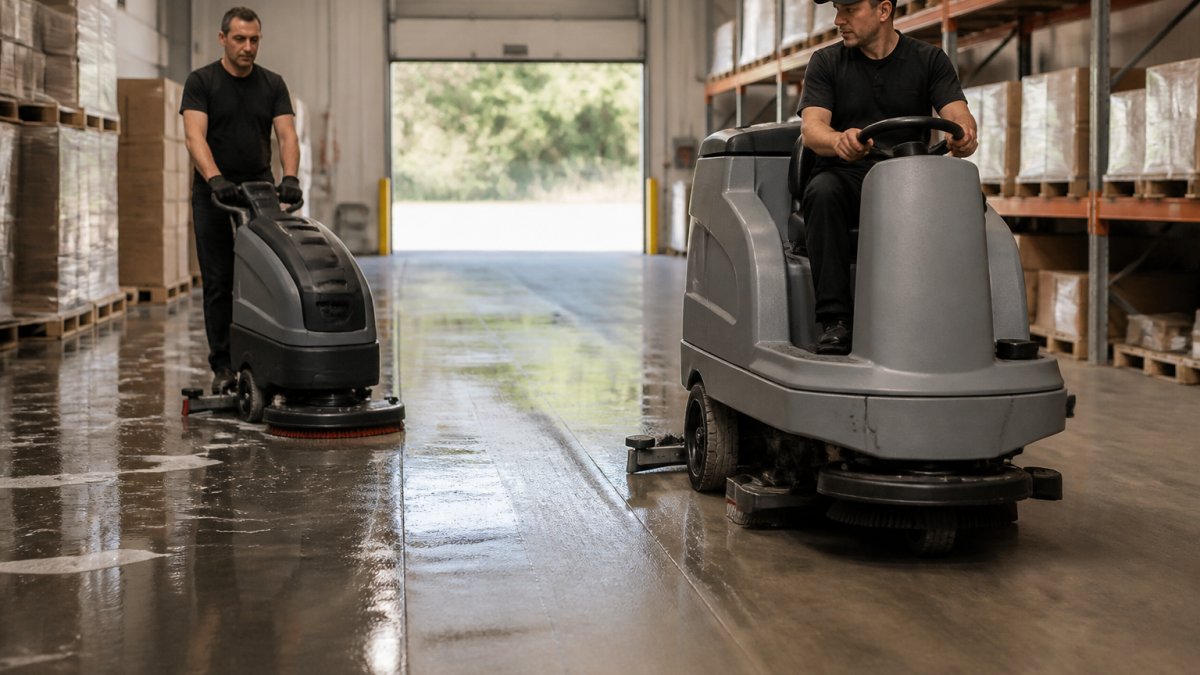
A ride-on scrubber trades upfront cost and storage space for speed across large areas; a walk-behind trades coverage speed for a lower price and better access in tight spaces.
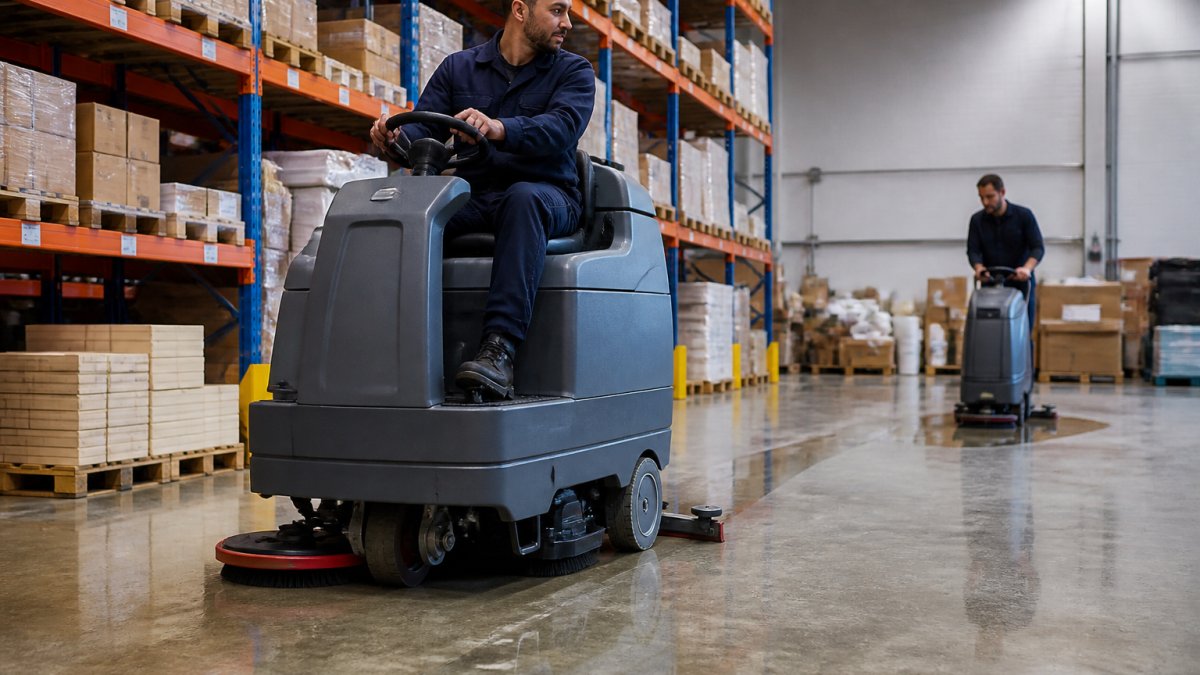
Ride-on units carry wider decks and larger tanks, meaning fewer refill stops and more continuous cleaning. Walk-behind machines are smaller, lighter, and easier to manoeuvre around pallets, racking, and doorways.
Cleaning Speed and Productivity on Large Open Spaces
On large open floors, ride-on scrubbers win: a wider deck cleans more width per pass, and the operator covers ground faster without walking fatigue, letting one person clean a bigger footprint per shift.
Walk-behind machines keep up on smaller floors, but the gap widens as floor area grows. On thousands of square metres of open space, a ride-on usually finishes in a fraction of the time.
Manoeuvrability in Narrow Aisles and Cluttered Spaces
Manoeuvrability is where walk-behind scrubbers win outright: a tighter turning radius and narrower body let them work around obstacles, between racking, and through doorways a ride-on cannot enter.
With narrow aisles, dense storage, or frequent obstacles, a ride-on spends more time reversing and repositioning than cleaning, eroding its speed advantage fast. Many facilities run both: a ride-on for open floor, a walk-behind for tight zones.
How to Calculate Floor Scrubber Cleaning Capacity Per Hour
Floor scrubber cleaning capacity per hour is calculated by multiplying scrub deck width by realistic travel speed, then adjusting for turns, refills, and operator pace. The theoretical figure always exceeds what you achieve on site, so build in a realistic efficiency factor rather than trusting the brochure number.
Use this method:
- Measure your scrub deck width in metres.
- Estimate realistic travel speed in metres per minute, not the maximum.
- Multiply width by speed by 60 to get square metres per hour.
- Apply a reduction for turns, refills, and obstacles (a common approach is to plan for roughly 70 to 80 per cent of the theoretical figure).
A walk-behind with a narrower deck and slower travel produces lower hourly capacity than a ride-on with a wide deck and faster travel, the calculation makes that gap concrete.
Floor Scrubber Coverage Rate Calculation: A Like-for-Like Method
Floor scrubber coverage rate calculation only works as a comparison when you use identical assumptions for both machines. Spec sheets quote best-case coverage, making walk-behind and ride-on figures look closer than they are. Build a realistic productivity model that accounts for everything between the start and end of a shift.
The four inputs that actually determine coverage
Every realistic coverage figure comes from four inputs:
- Effective deck width, the scrub deck width in metres, minus any overlap you need between passes to avoid streaks. A common overlap allowance is 5 to 10 per cent, so a 0.7 m deck behaves like roughly 0.63 to 0.67 m of effective coverage.
- Realistic travel speed, the speed an operator sustains over a shift, not the machine's top speed. Operators slow for corners, doorways, pedestrians, and wet-floor signage. A common pattern is to plan at 60 to 75 per cent of the rated maximum.
- Efficiency factor, the proportion of shift time actually spent scrubbing. This is where turns, refills, squeegee checks, battery swaps, and mandated breaks bite. A common planning range is 65 to 80 per cent for open floors and 45 to 60 per cent for cluttered layouts.
- Shift length, the paid hours available, not the machine's runtime.
The formula: effective width (m) × realistic speed (m/min) × 60 × efficiency factor = realistic square metres per hour.
A worked comparison
Assume a 2,000 m² open warehouse floor, one operator, an eight-hour shift, and a 70 per cent efficiency factor for both machines so the comparison is honest.
| Input | Walk-behind | Ride-on |
|---|---|---|
| Deck width | 0.7 m | 1.0 m |
| Effective width (after 8% overlap) | 0.64 m | 0.92 m |
| Realistic speed | 3.5 km/h (≈58 m/min) | 6 km/h (≈100 m/min) |
| Theoretical coverage | ≈2,240 m²/h | ≈5,520 m²/h |
| Efficiency factor | 70% | 70% |
| Realistic coverage | ≈1,570 m²/h | ≈3,860 m²/h |
| Time to clean 2,000 m² | ≈1.3 hours | ≈0.5 hours |
Those figures are illustrative, not a quote for any machine. The point is the method: hold the efficiency factor constant, use effective width rather than nominal width, and use a speed the operator can sustain.
Why the efficiency factor matters more than the deck width
On a cluttered floor, the efficiency factor collapses: frequent reversing, pedestrian interruptions, and refill stops can pull it to 45 to 60 per cent.
Measure your own floor before trusting any comparison: time a single pass through your worst aisle, count the refills a tank delivers, and note how often the operator stops. Those three observations tell you more about real coverage than any spec sheet.
Where the like-for-like method changes the answer
On a large open floor with long runs and few obstacles, the ride-on's wider deck and faster sustained speed compound, and the coverage gap is real. On a floor broken into rooms, aisles, and storage zones, the efficiency factor dominates, and the walk-behind often matches or beats the ride-on per shift. Many sites run both, usually the most efficient configuration rather than a compromise.
Walk-Behind vs Ride-On Floor Scrubber Cost: Purchase, Labour, and TCO
Walk-behind vs ride-on floor scrubber cost is not decided by purchase price alone. Labour, maintenance, and downtime usually outweigh the upfront difference over the machine's life. Total cost of ownership is the only honest comparison, and it only works when modelled over a defined horizon with stated assumptions.
The cost lines that belong in the model
A defensible TCO comparison includes:
- Acquisition, purchase price, or lease and finance costs spread across the term.
- Labour, the largest line for most sites. Multiply realistic cleaning hours per shift by the loaded hourly rate (wages plus on-costs such as superannuation, leave, and workers' compensation).
- Consumables, water, detergent, and pads or brushes, which scale with cleaning hours and floor condition.
A three-year and five-year view
Because prices vary by deck size, battery type, and configuration, model the shape of the cost rather than quote a single figure. Set up a spreadsheet with one column per machine and one row per cost line, then total it over three years and again over five.
A common pattern looks like this:
| Cost line | Walk-behind | Ride-on |
|---|---|---|
| Acquisition | Lower | Higher |
| Labour per clean | Higher (more hours) | Lower (fewer hours) |
| Consumables per clean | Similar per m² | Similar per m² |
| Battery replacement | Lower cost, similar interval | Higher cost, similar interval |
| Maintenance | Lower absolute cost | Higher absolute cost |
| Downtime exposure | Lower per event | Higher per event |
| Storage | Minimal | Significant |
The crossover point is where cumulative labour savings overtake the higher acquisition and maintenance cost. On a large open floor with high loaded labour rates, that can arrive within a year or two.
Return on investment and payback period
Return on investment comes down to labour hours saved. If a ride-on halves the time to clean a large floor, the saving accumulates every shift, and the payback period is where those savings cover the higher purchase price.
Work it in three steps:
- Calculate hours saved per clean (walk-behind hours minus ride-on hours).
- Multiply by cleans per week, weeks per year, and the loaded hourly rate to get annual labour saving.
- Divide the price premium by the annual saving to get payback in years.
Under two years, the ride-on is usually the stronger financial case. Beyond four or five years, the walk-behind's lower capital outlay and downtime exposure usually win.
The costs buyers forget
Three lines routinely get left out and routinely change the answer:
- Downtime. A ride-on machine that fails mid-shift on a large floor cannot be substituted with a walk-behind unit without a significant time penalty. Factor in the cost of a contractor callout or overtime.
- Battery replacement. A battery pack is a scheduled cost, not a failure. Spreading it across the ownership period is more honest than ignoring it.
- Training and induction. Both machine types need trained operators, but ride-on units typically need more induction time for safe pedestrian interaction and visibility management.
For facilities with large open floors and high labour costs, payback can arrive quickly. For smaller sites, the walk-behind's lower price often wins because the ride-on's speed advantage never gets used. Match the machine to the floor, and the maths works.
Operator Ergonomics, Training, and Safety
Operator comfort affects efficiency more than most buyers expect: a tired operator works slower, makes more mistakes, and is more likely to have an incident. Ride-on machines reduce walking fatigue; walk-behind machines demand more physical effort over a shift.
Training matters just as much: a poorly trained operator on a good machine underperforms a well-trained operator on a basic one.
Floor Scrubber Maintenance Checklist for Peak Efficiency
A floor scrubber maintenance checklist keeps efficiency high and downtime low. Neglected machines lose suction, streak floors, and fail mid-shift, destroying your coverage rate. Build these checks into a daily and weekly routine.
- Squeegee blades: check for wear, flip or replace as needed
- Recovery tank: empty and rinse after every use
- Solution tank and filter: flush to prevent blockages
A few minutes of daily care protects the efficiency you paid for. Skipping it quietly erodes both cleaning performance and machine life.
Which Scrubber Fits Your Facility? A Decision Framework
The right scrubber matches your floor area, layout, and labour reality, not the best spec sheet. Use these questions:
- Is your cleanable floor mostly large and open? A ride-on scrubber will usually win on efficiency.
- Do you have narrow aisles, dense storage, or frequent obstacles? A walk-behind scrubber gives you the access you need.
- Is labour your biggest cost? Faster coverage per hour pays back quickly.
If the decision still feels close, your floor area is borderline and either machine will work. For larger commercial and industrial sites, professional high-pressure cleaning and floor care can handle the heavy-duty work your in-house equipment cannot reach.
Frequently Asked Questions
Are ride-on floor scrubbers more efficient than walk-behind scrubbers?
Ride-on scrubbers typically cover more floor area per hour because they travel faster and carry larger tanks, reducing refill stops. On large open floors, this can mean significantly higher cleaning productivity. However, walk-behind models are more efficient in tight, cluttered spaces where a ride-on unit cannot manoeuvre or turn easily. The right choice depends on your facility layout, obstacle density, and cleanable floor area.
How do you calculate the operating cost of a floor scrubber?
Add upfront purchase price, maintenance costs, battery replacement or charging, water and detergent use, and labour. Divide total annual cost by cleanable floor area to get cost per square metre. For a like-for-like comparison, use the same time horizon, such as five years, and the same labour rate. This total cost of ownership approach shows whether a higher-priced ride-on scrubber pays back through lower labour hours.
What factors affect a floor scrubber's cleaning productivity?
Cleaning speed, scrub deck width, tank capacity, turning radius, floor type, obstacle density, and operator skill all affect output. Battery life and water consumption also determine how long the machine runs between stops. Facility layout matters most: a wide-open warehouse favours a ride-on scrubber, while narrow aisles and cluttered spaces suit a walk-behind unit. Measure your actual cleanable floor area, not total building size.
Which type of floor scrubber is best for a large facility?
For large open spaces with few obstacles, a ride-on scrubber usually wins on coverage rate and labour efficiency. It cleans more square metres per hour, so one operator can cover more ground per shift. For facilities with mixed layouts, narrow aisles, or multiple small rooms, a walk-behind scrubber may be faster overall because it turns tighter and fits through standard doorways. Run a coverage rate calculation for your specific floor plan before deciding.
Choosing the wrong scrubber locks you into years of higher labour costs, extra maintenance, and slower cleaning than your facility needs. AquaBlast Elite offers high-pressure cleaning services with cutting-edge equipment, customised solutions for every site, and skilled professionals who restore surfaces across commercial and industrial properties. Get started with AquaBlast Elite and keep your floors cleaner with less effort.