 blog
blog
Top 5 Industrial Floor Cleaning Machines for Warehouses
Table of Contents
- What to Look For in an Industrial Floor Scrubber
- Top 5 Industrial Floor Cleaning Machines for Warehouses
- Walk-Behind vs Ride-On Floor Scrubbers
- Warehouse Floor Cleaning Safety Regulations
- Industrial Floor Scrubber Maintenance Checklist
- Total Cost of Ownership and Surface Compatibility
- Frequently Asked Questions
Last Updated: September 28, 2026
What to Look For in an Industrial Floor Scrubber
Choosing the wrong machine costs more than the purchase price. It costs labour hours, rework, and premature floor wear. This guide from AquaBlast Elite breaks down what actually matters when you're comparing industrial floor cleaning machines, so you can match a unit to your facility instead of guessing from a spec sheet.
Two specifications decide almost everything else.
Tank Capacity and Battery Runtime
Solution and recovery tank size sets how long you can clean before stopping to refill or empty. Battery runtime sets the ceiling on that same window. A machine with a large tank and a short runtime still stops early; a long runtime with a small tank just means more refill trips.
Scrubbing Width and Suction Power
Scrubbing width is the path cleaned per pass, and it drives productivity more than any other number. A wider deck covers more floor per hour but struggles in tight aisles and around racking. Suction power determines how dry the floor is when you leave it. On polished concrete and sealed surfaces, dry-in-one-pass matters for safety and for floor finish protection.
Top 5 Industrial Floor Cleaning Machines for Warehouses
The five categories below cover nearly every warehouse scenario, from a 500 square metre workshop to a 20,000 square metre distribution centre. Each entry gives you the productivity band, the tank and runtime reality, and the layout constraint that decides whether it fits, because picking the wrong category is the most expensive mistake in floor care equipment.
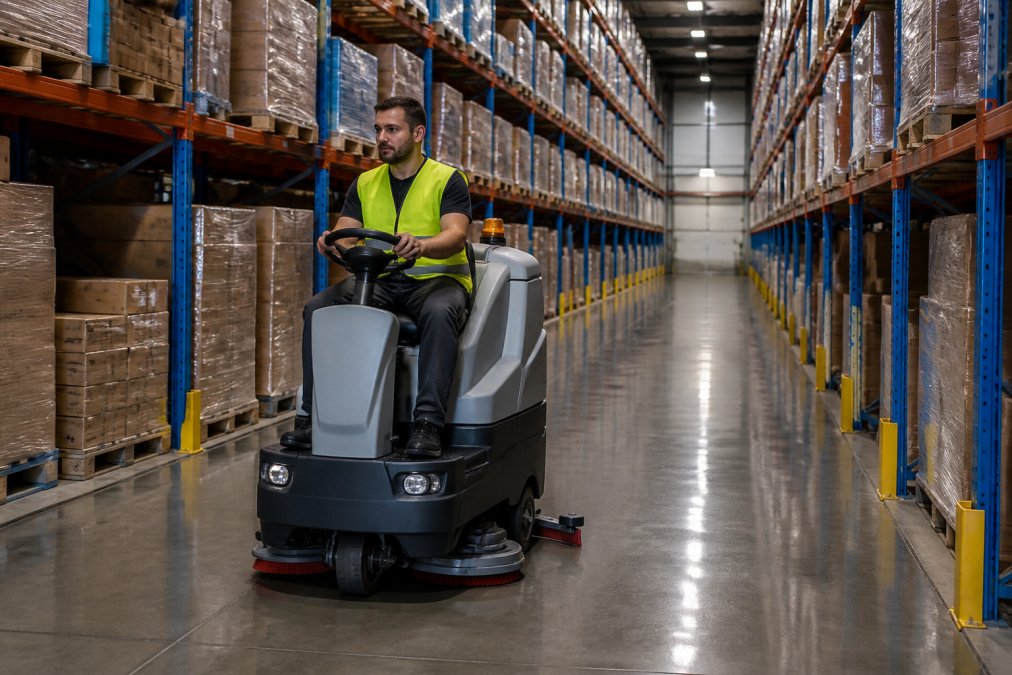
1. Heavy-Duty Ride-On Scrubber Dryer
Best for large open floors above roughly 5,000 square metres. A ride-on scrubber dryer covers wide aisles fast, carries large tanks, and keeps the operator seated for long passes. Typical units in this class run scrubbing decks around 700-1,000 mm and solution tanks in the 100-200 litre range, which is what lets them stay productive across a long pass instead of stopping to refill.
2. Compact Walk-Behind Floor Scrubber
Best for congested layouts, mezzanines, and mixed-use floors. A walk-behind scrubber fits where ride-on units can't, and the operator sees the floor directly, which helps around pallet edges and dock doors. Decks typically sit in the 350-550 mm range with tanks around 20-60 litres, so these suit shorter, more frequent cleaning blocks rather than a full shift in one pass.
3. Autonomous Cleaning Robot
Best for repeatable, scheduled passes on predictable routes. An autonomous cleaning robot handles routine scrubbing overnight or between shifts, which reduces labour cost and frees staff for other tasks. The productivity claim only holds if the route is genuinely repeatable, a mapped, obstacle-light aisle network with consistent pallet positions.
4. Industrial Sweeper-Scrubber Combo
Best for facilities with both loose debris and wet soil. A combo unit sweeps before it scrubs, so debris collection and wet cleaning happen in one pass. That's valuable in loading docks and production areas where cardboard, dust, and spills mix, sweeping first also stops debris from being dragged into the squeegee and smeared across the floor.
5. Battery-Powered Rider Scrubber
Best for facilities that need quiet, fume-free operation. Battery-powered rider scrubbers suit food-adjacent and indoor environments where exhaust is a problem. Battery runtime and charging strategy matter more here than on any other unit, a lead-acid pack typically needs a full charge cycle and water top-ups, while lithium-ion packs support opportunity charging between shifts.
| Machine | Best For | Key Strength | Main Trade-Off |
|---|---|---|---|
| Ride-on scrubber dryer | Large open floors | High coverage per hour | Needs turning space |
| Compact walk-behind | Tight aisles, mezzanines | Fits congested layouts | Frequent refills, operator fatigue |
| Autonomous robot | Scheduled routine passes | Cuts labour hours | Limited on heavy soil, needs mapped route |
| Sweeper-scrubber combo | Mixed debris and wet soil | One-pass sweeping and scrubbing | More maintenance |
| Battery rider scrubber | Fume-free indoor areas | Quiet, no exhaust | Battery logistics |
Walk-Behind vs Ride-On Floor Scrubbers
The choice between walk-behind and ride-on floor scrubbers comes down to floor area and layout, not budget alone. Walk-behind units win on tight, obstructed floors; ride-on units win on large, open ones.
Warehouse Floor Cleaning Safety Regulations
Floor cleaning in a warehouse is a work health and safety matter, not just a housekeeping task. Under Australia's model work health and safety laws, a person conducting a business or undertaking must manage risks to workers and others, and wet floors are a recognised slip hazard.
Practical compliance steps:
- Use wet-floor signage and barricades during and after cleaning
- Schedule cleaning outside peak pedestrian and forklift traffic
- Keep pedestrian walkways separate from mobile plant routes
- Train operators on the specific machine and its safe use
- Record cleaning and maintenance in your floor maintenance schedule
Industrial Floor Scrubber Maintenance Checklist
A consistent industrial floor scrubber maintenance checklist prevents most breakdowns and keeps cleaning results steady. Run this after every shift, then weekly.
- Empty and rinse the recovery tank
- Drain and flush the solution tank
- Remove and rinse debris from the squeegee blade
- Check brushes or pads for wear and replace as needed
- Inspect hoses and connections for leaks
- Clean the vacuum filter
- Check battery water levels and charge state
- Test the emergency stop and safety features
- Log any faults for the next service
Total Cost of Ownership and Surface Compatibility
Purchase price is the smallest number in the equation. Total cost of ownership adds labour, consumables, maintenance, downtime, and the floor damage a mismatched machine can cause. Most procurement decisions go wrong because the buyer optimises the sticker price and ignores the labour line, which is usually the largest cost over the machine's working life.
Floor Surface Compatibility Guide
Match the machine and brush to the surface before you commit. The wrong brush doesn't just clean poorly, it can strip a coating that cost more to apply than the machine cost to buy.
| Surface | Recommended Setup | Avoid |
|---|---|---|
| Sealed or polished concrete | Medium brush, standard squeegee | Aggressive abrasive pads |
| Unsealed concrete | Soft to medium brush | Over-wetting, which drives dust into the slab |
| Epoxy coatings | Soft brush, low pressure | Hard bristle brushes, which scratch the coating |
| Vinyl and tile | Soft pad, low moisture | Heavy scrubbing pressure, which lifts edges |
| Anti-slip safety flooring | Soft brush, gentle pass | High-pressure scrubbing, which wears the profile |
| Polished concrete with sealer | Soft pad, neutral cleaner | High-alkaline chemicals, which dull the sealer |
TCO Calculator Basics
To estimate annual cost of ownership, add these together: purchase price divided over expected years of service, plus annual labour hours multiplied by your hourly rate, plus consumables such as brushes and squeegee blades, plus scheduled servicing, plus an allowance for downtime.
Worked example for a mid-size facility:
- Machine purchase price: divide by expected service life (commonly 5-8 years for a well-maintained scrubber) to get an annual capital cost.
- Labour: cleaning hours per week × 52 × your loaded hourly rate. This is usually the biggest line.
- Consumables: brushes, pads, squeegee blades, and cleaning chemicals, replaced on a wear schedule.
- Servicing: scheduled preventative maintenance plus an allowance for reactive repairs.
- Downtime: the cost of the floor not being cleaned when the machine is off the floor.
Operator Training and Certification
A TCO model is only as good as the operator running the machine. Poor technique, too much solution, worn squeegee, wrong brush, quietly doubles passes and accelerates wear on both the machine and the floor. Budget for induction training on the specific unit, refresher training when staff turn over, and a written safe operating procedure that covers the machine, the chemicals, and the wet-floor controls.
Frequently Asked Questions
What is the best commercial floor cleaning machine for large warehouses?
The best machine depends on aisle width, floor type, and daily run time. Ride-on scrubber dryers suit wide open spaces over 2,000 square metres, while walk-behind units fit narrow aisles and racking. Check tank capacity, battery runtime, and scrubbing width against your facility layout. For mixed environments, a sweeper-scrubber combo reduces the number of passes needed and lowers labour cost per shift.
What are the key differences between a floor sweeper and a scrubber dryer?
A sweeper collects dry debris like dust, packaging scraps, and grit using brushes and a vacuum system. A scrubber dryer applies cleaning solution, agitates it with brushes, then vacuums the dirty water back into a recovery tank. Warehouses with fine dust and occasional spills often need both functions. Combination units handle debris collection and wet scrubbing in one pass, which saves time on high-traffic concrete floors.
What safety standards must warehouse cleaning equipment meet?
Warehouse floor cleaning equipment should comply with Work Health and Safety (WHS) regulations, which require risk assessments, operator training, and safe chemical handling. Machines must have emergency stop functions, visible warning lights, and non-slip tyres. Cleaning schedules should avoid peak forklift traffic times. Check that all cleaning chemicals have current Safety Data Sheets (SDS) and are stored per dangerous goods requirements.
How do I choose the right industrial floor cleaner for concrete surfaces?
Sealed concrete suits most scrubber dryers with soft or medium brushes. Unsealed or polished concrete needs gentler pads to avoid surface damage. For heavy-duty cleaning on concrete with oil or grease, choose a machine with high suction power and a pre-sweep function. Always test a small area first. Match brush pressure and chemical type to your floor finish to protect the surface and extend its lifespan.