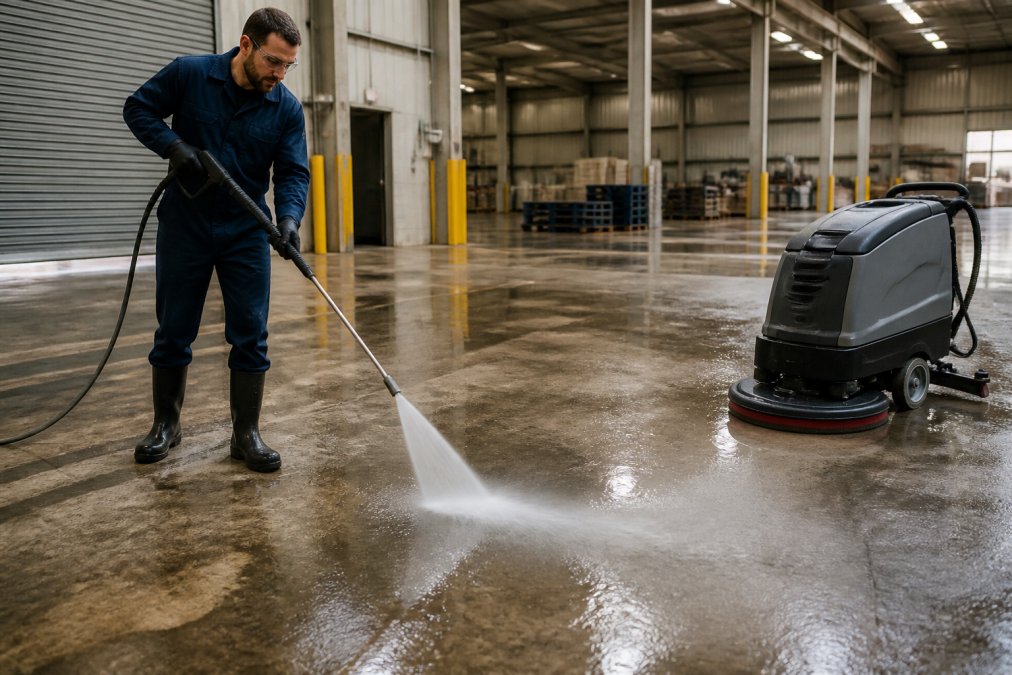
 how-to
How to Clean Industrial Concrete Floors Effectively
Table of Contents
- What You'll Need Before You Start
- Step 1: Clear Debris and Dust Mop Industrial Concrete Floors
- Step 2: Choose the Right Industrial Concrete Floor Degreaser
- Step 3: Scrubbing and Machine Cleaning Techniques
- Step 4: Removing Oil Stains from Concrete
- Step 5: Build a Concrete Floor Maintenance Schedule
- Safety, Compliance and Equipment Care
- Common Mistakes to Avoid
- Frequently Asked Questions
Last Updated: September 25, 2026
What You'll Need Before You Start
Cleaning industrial concrete floors effectively starts with the right gear, not the strongest chemical. Concrete is porous, and whatever you put on it soaks in.
Gather these basics first:
- A dust mop or industrial broom
- A wet/dry vacuum or squeegee
- A microfibre mop
- An industrial floor scrubber or auto-scrubber
- A pH-neutral cleaner
- A concrete floor degreaser for greasy zones
- Personal protective equipment: gloves, boots, eye protection
Step 1: Clear Debris and Dust Mop Industrial Concrete Floors
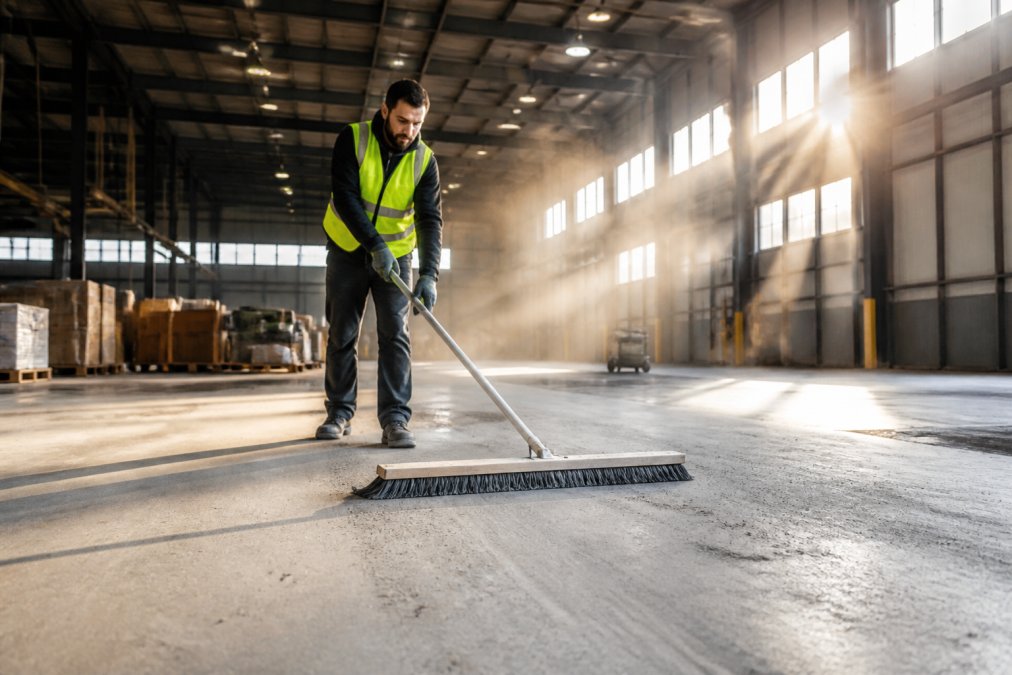
Dry cleaning comes before wet cleaning, every time. Skip this and you'll turn dust into mud that grinds into the surface.
Start with debris removal:
- Sweep or dust mop the full area, working from the back wall toward the exit.
- Pick up loose grit, metal shavings, and packaging scraps.
- Vacuum fine dust from corners and expansion joints.
- Check drains and grates for blockages.
Step 2: Choose the Right Industrial Concrete Floor Degreaser
Match the cleaner to the soil, not to the label. A pH-neutral cleaner handles routine dirt. An industrial concrete floor degreaser handles oils, fats, and grease.
Here's how the main options compare:
| Cleaner Type | Best For | Watch Out For |
|---|---|---|
| pH-neutral cleaner | Daily mopping, sealed floors | Weak on heavy grease |
| Degreaser | Oil, fat, workshop grime | Can dull unsealed surfaces |
| Citrus-based cleaner | Light grease, odour control | Can leave residue |
| Abrasive cleaners | Stubborn stains only | Scratch the surface |
| Ammonia or bleach | Rare, targeted use | Chemical damage risk |
pH-Neutral Cleaners vs. Abrasive Chemicals
pH-neutral cleaners protect the floor finish and the protective coating. They lift everyday dirt without eating into the surface.
Sealed vs. Unsealed Concrete: What Changes
Sealed concrete has a protective coating. It wipes clean, tolerates more moisture, and holds its finish.
Step 3: Scrubbing and Machine Cleaning Techniques
Machine cleaning does the heavy lifting on large floors. An industrial floor scrubber or auto-scrubber applies solution, scrubs, and vacuums in one pass.
For best results:
- Pre-treat greasy zones with degreaser, then wait 5-10 minutes.
- Set the scrubber brush to match the floor. Soft brushes for sealed concrete, stiffer for unsealed.
- Work in overlapping lanes so you don't miss strips.
- Change dirty water often. Dirty water just redeposits soil.
- Squeegee or wet-vac the edges the machine can't reach.
Step 4: Removing Oil Stains from Concrete
Removing oil stains from concrete takes speed and the right method. Fresh spills lift easily. Old, soaked-in stains need patience. But oil is only one of the soils an industrial floor carries, and treating every stain the same way wastes labour and can set the stain permanently.
Match the Method to the Soil
Use this as a first-response guide. Always test on a hidden patch first, and always check the product's safety data sheet before use.
| Stain Type | First Response | Follow-Up | Watch Out For |
|---|---|---|---|
| Fresh oil or hydraulic fluid | Blot, don't wipe. Cover with absorbent powder (kitty litter, diatomaceous earth) for 2-4 hours | Degreaser, stiff brush, rinse | Wiping spreads the stain and pushes it deeper into pores |
| Old, soaked-in oil | Poultice: absorbent powder plus a solvent, covered, left 12-24 hours | Repeat poultice if a shadow remains | Solvent fumes in enclosed spaces; ventilate |
| Grease and food fats | Scrape off solids, then hot water plus a heavy-duty degreaser | Agitate with a deck brush, wet-vac up | Cold water sets the grease back onto the surface |
| Tyre marks | A commercial tyre-mark remover or a floor scrubber with a black pad | Rinse and dry | Abrasive pads can dull sealed finishes |
| Coolant and cutting fluid | Dilute degreaser, dwell 5-10 minutes | Scrub, rinse, repeat | These fluids often carry biocides; check the SDS |
| Rust stains | A dedicated rust remover (oxalic-acid based) | Rinse thoroughly | Acids etch unsealed concrete if left too long |
| Chemical spills | Identify the chemical first, then neutralise or dilute per the SDS | Contain runoff before rinsing | Never mix unknown chemicals; some react violently |
| Dyes and inks | Solvent-based cleaner or a poultice | Repeat as needed | Solvents can lift sealer; spot-test first |
The Poultice Method, Step by Step
A poultice draws the stain out of the pores rather than scrubbing it around the surface. It is the single most effective technique for old oil and rust on unsealed concrete.
- Mix an absorbent powder (diatomaceous earth, fuller's earth, or talc) with just enough solvent or water to form a thick paste.
- Spread the paste 6-10 mm thick over the stain, extending 25 mm past the edges.
- Cover with plastic film and tape the edges down. This stops the solvent evaporating before it has drawn the stain out.
- Leave it 12-24 hours. Longer for deep stains.
- Remove the dried poultice and rinse. If a shadow remains, repeat.
Prevention Beats Cure
Seal high-risk zones, around machinery, under vehicles, at loading docks, and fix leaks at the source. A drip tray under a leaking forklift costs far less than restoring a stained slab. Log every spill so you can spot the equipment or process that keeps causing them.
Step 5: Build a Concrete Floor Maintenance Schedule
A concrete floor maintenance schedule turns cleaning from a crisis into a routine. Frequency depends on traffic and soil type.
| Zone | Dust Mop | Wet Clean | Deep Clean |
|---|---|---|---|
| High-traffic areas | Daily | Daily | Monthly |
| Production floors | Daily | 2-3x weekly | Monthly |
| Storage zones | Weekly | Weekly | Quarterly |
| Low-use areas | Weekly | Monthly | Biannually |
Add preventative maintenance tasks:
- Inspect the protective coating each quarter
- Re-seal worn zones before stains take hold
- Log spills and stains to spot repeat problem areas
- Check slip resistance after every deep clean
Safety, Compliance and Equipment Care
Safety and compliance aren't optional extras. They protect your staff, your business, and your floor's service life. This is also where a cleaning program earns its budget, or loses it.
The Compliance Framework
In Australia, industrial cleaning sits under the model work health and safety (WHS) laws, which each state and territory adopts through its own regulator (for example, SafeWork NSW, WorkSafe Victoria, WorkSafe Queensland). The duties that matter most for floor cleaning are:
- Hazard identification and risk control. You must identify hazards (slips, chemical exposure, machinery) and control them using the hierarchy of controls.
- Hazardous chemicals. Obtain and follow the safety data sheet (SDS) for every product. Maintain a register, label all decanted containers, and train staff on dilution ratios and emergency procedures.
- PPE. Provide gloves, boots, eye protection, and any respiratory protection the SDS specifies, and enforce their use.
- Environmental runoff. Trade waste and stormwater are regulated separately. Never let wash water or chemical runoff enter stormwater drains; check with your local water authority about trade waste discharge limits.
Slip Resistance: The Number That Matters
Slip resistance is measured as the coefficient of friction (COF). Wet cleaning temporarily lowers COF, and a poorly rinsed floor can stay slippery long after it looks dry.
- Measure slip resistance with a pendulum or tribometer test, not by eye.
- Test after every deep clean, and after any change of cleaning chemical.
- Keep a written record. If an incident occurs, that record is your evidence that you managed the risk.
- Re-test whenever the surface is re-sealed or polished, because the finish changes the COF.
Equipment Care That Protects the Clean
A dirty machine cannot clean. Rinse scrubber solution and recovery tanks after every use, biofilm builds in warm, damp tanks within days and re-contaminates the floor on the next pass. Clean brushes and squeegees, check batteries and hoses weekly, and replace worn squeegee blades before they start leaving streaks. A well-kept auto-scrubber cleans better and lasts years longer.
In-House vs. Outsourced: A Cost-Benefit View
Facility managers should decide this on total cost, not hourly rate.
| Factor | In-House | Outsourced |
|---|---|---|
| Equipment capital | You buy and maintain the scrubber | Contractor supplies it |
| Labour | Wages, training, supervision, turnover | Fixed contract rate |
| Compliance | You own the WHS and chemical duties | Contractor shares the duty, but you still must verify |
| Flexibility | Limited to your roster and skills | Scales up for shutdowns and deep cleans |
| Best for | Large, steady, predictable floor areas | Specialist stains, periodic deep cleans, peak periods |
Common Mistakes to Avoid
Most damage comes from a handful of repeated errors.
- Using too much water on unsealed concrete
- Reaching for bleach or ammonia as a default
- Skipping dust mopping before wet cleaning
- Letting dirty water sit on the floor
- Ignoring equipment maintenance until it fails
- Cleaning without a schedule
A common mistake is treating all concrete the same. It isn't. Porosity, coating, and traffic all change the approach.
Frequently Asked Questions
What is the best way to remove oil stains from industrial concrete?
Start by absorbing as much oil as possible with an absorbent material, then apply a dedicated industrial concrete floor degreaser and let it dwell for 10-15 minutes. Agitate with a stiff brush or auto-scrubber, then rinse and extract the residue. For deep-set stains on unsealed concrete, you may need to repeat the process. Sealed floors respond faster because the oil stays on the surface. Avoid solvent-based products on sealed concrete, as they can break down the protective coating.
How often should industrial concrete floors be deep cleaned?
The right concrete floor maintenance schedule depends on traffic and contamination levels. High-traffic areas with grease or chemical exposure typically need deep cleaning weekly, while lighter-use zones can go monthly. Daily dust mopping and spot cleaning keep surface contaminants from bonding to the concrete. A written schedule that maps zones to frequency helps facility managers stay consistent and prevents the build-up that shortens floor longevity.
Can high-pressure cleaning damage industrial concrete surfaces?
Yes, if the pressure is too high or the nozzle is held too close. Excessive pressure can erode the surface paste, widen existing cracks and strip protective coatings, reducing slip resistance. For most industrial concrete floors, a scrubbing machine or auto-scrubber with the right chemical is safer and more effective than a pressure washer. If pressure cleaning is necessary, use a rotating surface cleaner rather than a straight jet, and keep the wand moving to avoid etching.
What cleaning agents are safe for sealed versus unsealed concrete?
Sealed concrete tolerates pH-neutral cleaners and mild degreasers without damaging the protective coating. Avoid abrasive cleaners, strong acids and ammonia-based products, which dull the finish and shorten the coating's life. Unsealed concrete is more porous and can handle stronger degreasers, but bleach, vinegar and citrus-based cleaners should be used with care because they can leave residue or gradually weaken the surface. Always test a small area first and follow the manufacturer's dilution instructions.
Industrial concrete floors take a beating, and keeping them clean takes more than a mop and bucket. AquaBlast Elite delivers high-pressure cleaning for concrete, decks, and graffiti across the region, using cutting-edge equipment and customized solutions for every project. Our skilled professionals restore and rejuvenate surfaces so they look brand new. Get started with AquaBlast Elite and book a call to protect your floors for the long term.